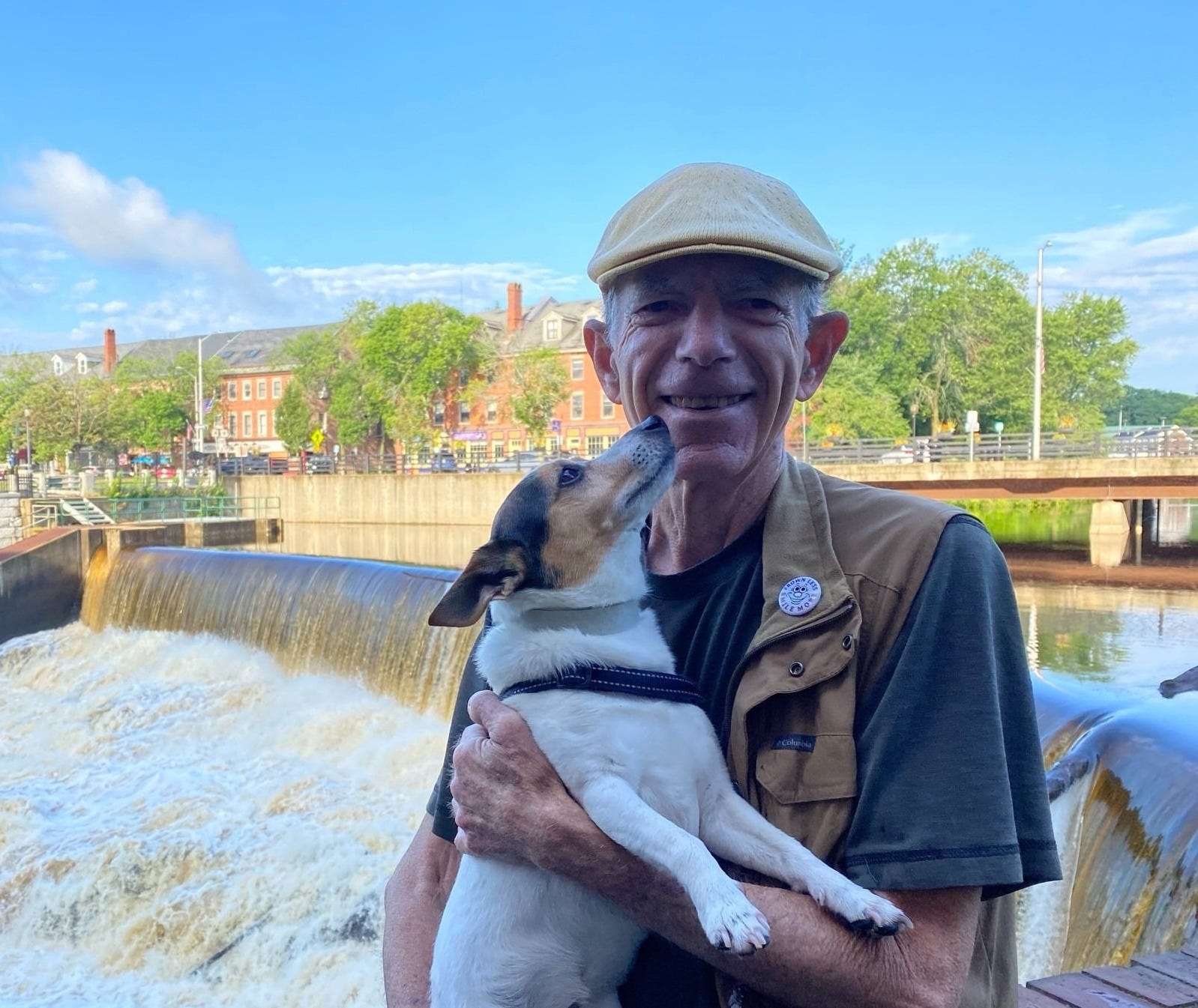
There are people who walk their dogs. And then there’s Jeff Bernstein.
Most mornings, he and Mozy—his eleven-year-old Jack Russell—can be spotted in his signature vest and hat near the Silver Street roundabout. People honk. They wave. They smile. During 2020, Jeff noticed that businesses were struggling to survive financially due to the pandemic. He and Mozy started visiting storefronts, snapping photos, and posting to Facebook. Since then, he’s been written about in Foster’s Daily Democrat and officially honored by the city for what Mayor Robert Carrier called “exceptional citizenship and tireless dedication to building a vibrant and inclusive community.”
Jeff made a living one car show at a time. He spent his weekends on blacktop, weekdays restocking inventory, and chasing the next hustle. At his peak, he set up at 48 antique auto shows a year, plus a Monday flea market near Disney, moving seasonally between New Hampshire and Florida.
And ever the pitch man, after the psychic toll the Pandemic had taken on people, after seeing how isolated and disconnected the community had become, Jeff launched the Every Smile Counts initiative. Jeff believed small acts of kindness, like smiling at a stranger, can improve both the giver’s and receiver’s mental well-being. So the idea was to quantify kindness. To not only raise awareness but to create new habits in people. Using his own money, he purchased baseball-style clicker counters. He designed and printed custom labels for the clickers. The idea was that people would carry these clickers and click every time they smiled at someone or performed a small act of kindness. Think analog Fitbit for the soul instead of steps.
“You know, the whole point behind the clicker was just to help people, especially coming out of COVID, right? To help people feel more connected, to do that small act of kindness,” said Jodi Langellotti, who first met Jeff on the community trail back when she ran for city council.
“I got to meet Mozy,” she said, “and we had a really nice, hour-long walk and chat.”
Near the Route 108 trailhead, they noticed a large gouge in one of the new posts—something Jeff immediately assumed was graffiti. But Jodi saw it differently. “That’s not spray paint,” she told him. “That’s machinery damage. No one’s carving metal like that just to make a point.” Jeff paused, then admitted he would’ve stayed angry if she hadn’t spoken up. That moment—seeing the world through each other’s eyes—was the beginning of their friendship.
The Every Smile Counts initiative never really took off, but in 2023, Jeff began visiting nearly every business in Dover, documenting, uplifting, and marketing them.
“No one’s paying him to create these marketing materials,” said Jodi. “No one is paying him their ad spend. To have him literally promote their business and bring a cute dog into the equation. What a positive influence he is. It’s very rare that people don’t know him. People go oh yeah I’ve seen him downtown, or I saw him on Facebook. Even if they don’t know him personally, so many people know him.”
“You know, he cooks Mozy’s meals. He takes care of Mozy better than some people take care of their kids,” said Jodi.
But to really understand Jeff and why he does what he does, you have to know above all else, his is a love story. Not just with his dog, or his city, or even with kindness—everything Jeff builds, everything he gives, carries the shape of Corbe Feeney.
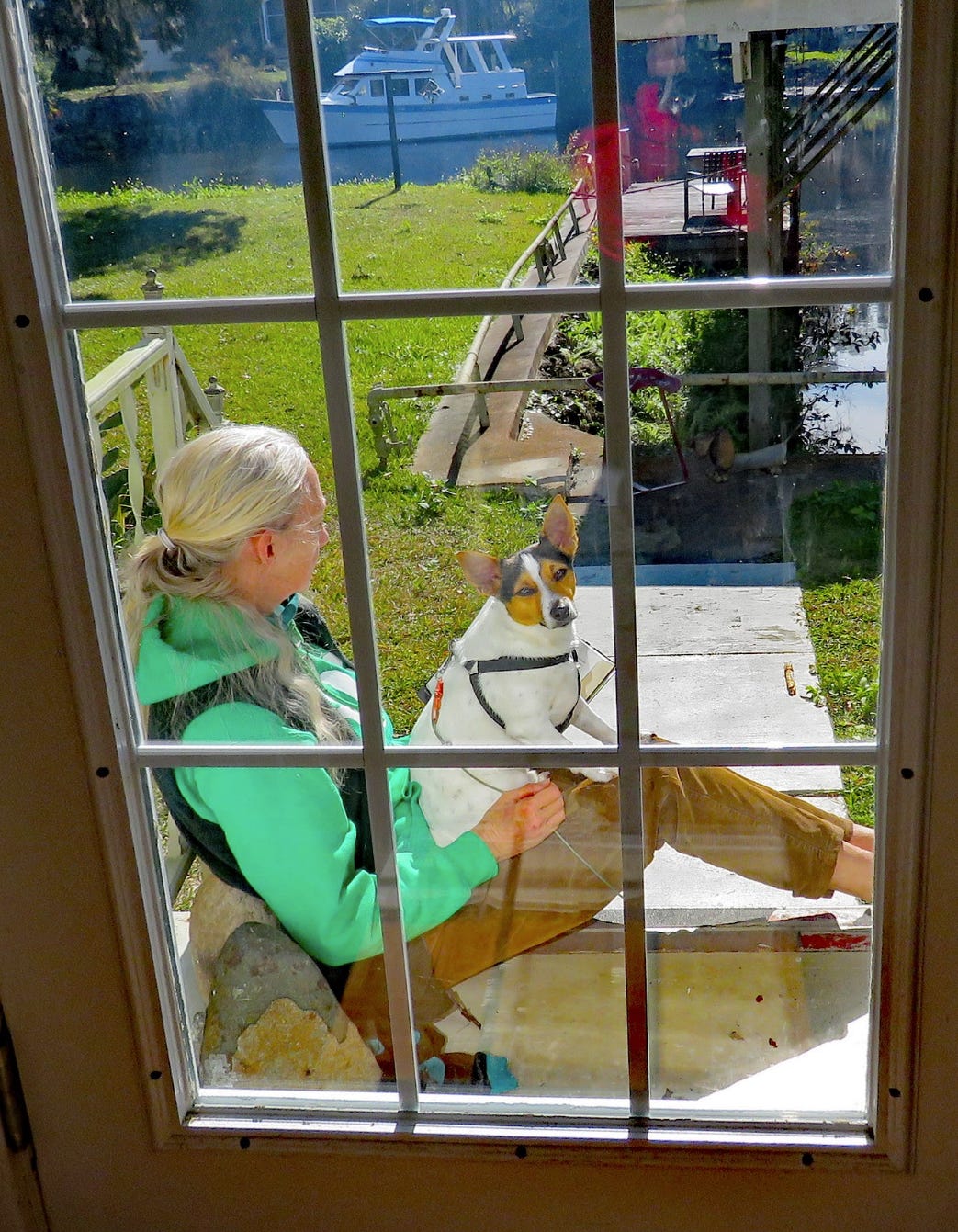
Corbe inherited a small Florida cracker house that sat on the edge of a canal. If the weather was good and the mosquitoes weren’t too bad, Corbe perched on the front steps with Mozy in her lap, watching the light move across the water, her silver hair pulled back, the dog sitting like a king. They lived there part of every year, refusing to call themselves snowbirds. “Seasonal travelers,” Jeff said. “That sounded more romantic. More honest.”
In the late 1970s, Jeff lived in Boston’s Back Bay selling Birkenstock in Harvard Square and had the highest-grossing store outside of Berkeley, California.
But behind the counter smiles and college-town rhythms, Jeff dealt with Crohn’s disease. He’d struggled with the condition since a teenager, and had been trying some alternative therapies that mostly didn’t work. Ultimately, Jeff opted for surgery, and the doctors removed a section of his intestine.
During recovery, his long-time friend Martin Held opened The Book Guild of Portsmouth in 1982, an antiquarian bookstore on the left-hand side of this brooding, symmetrical Victorian double-bay on Daniel Street
And Martin offered Jeff a job. “You know, I’m going to need a lot of help,” he said. So Jeff got a little apartment on South Street.
“He [Martin] was just this wonderful giving person who just sort of said he was my second father and his wife was my second mother, and they were amazing people, so I said, yeah, I think I’ll do that. And Marty, this guy, Marty, my friend Marty, said he had this person he wanted me to meet.”
“She’s a great woman,” Marty had said. “And I’d like you to meet her.”
And on their first date, they went dancing.
“We had a fondness for jazz,” said Jeff.
Often barefoot, Corbe radiated grounded elegance. A woman whose presence was deeply felt and deeply cultivated. Hats worn like punctuation. Posture confident but never stiff. Linen skirts, crisp collars, silver hair pulled back with precision and grace. She read voraciously. And she was funny too.
She didn’t speak much of the life she lived before Jeff, but you saw the shape of it in what she chose to love: dogs, old movies, quiet rituals, and Jeff.
“Out of my league, yeah, exactly,” said Jeff. Two souls in motion, bound by style, laughter, and the simple act of showing up, every day, side by side.
When his aunt was dying in North Andover, Jeff wheeled her outside in one of those block hospital lounge chairs that could go flat. Jeff had observed that 90% of the residents at that nursing home never had anyone visit. Statistically, 60% of nursing home residents receive no regular visits—meaning most people live their last chapters in near silence, rarely touched, and often forgotten.
“It’s just a horrendous place to be,” Jeff recounted. The smell of disinfectant, the sound of the television always on in the background “There’s no future for you. You can’t even think positively. It’s just hard. So I don’t want to be part of that. None of us do, I’m sure.”
Jeff’s aunt was not alone when she died. He had brought Mozy, who at the time was only eight months old. He lifted the terrier onto her chest as she reclined in the chair, her head propped, earbuds in place, listening to music she enjoyed. Mozy, wildly energetic most days, didn’t move. He looked up at her. Then pressed his little body flat against hers and remained—thirty, forty-five minutes, maybe a bit more. Breathing together. Music playing. Jeff sat with them both. And when she finally passed, that’s how she went: with her nephew nearby, her favorite songs in her ears, and a dog curled against her heart.
Jeff doesn’t talk about death the way most people do, and though he’s not panicked or obsessed with dying, he does speak plainly and deliberately. “I’m not looking at this fatally or fatalistically,” he said. “But if I had a way to program my death, what would be the wonderful way to go?”
Mozy turned eleven this past December—seventy-seven in dog years. Jeff turned seventy-seven this past June. “So we’re the same age now,” he said. “I always start with that—he’s eleven, and I’m eleven. And we’re the same age.”
Jeff grinned at the math. “It’s a great line.”
“I’m planning on leaving the planet together with my dog,” he said.
“I just hope I can leave this world the way I want to leave it,” he said. He’s written some of those wishes into his will. He’s done a little research on how to end things peacefully, on his terms. “But it’s in no way bogging me down mentally,” he said. “I look at it as a positive.”
“And so my goal is to keep us as healthy as possible under the conditions that, you know, that health conditions that I’m always working on a daily basis.”
But then, Jeff has become accustomed to doctors and hospitals since the many visits began when he was seventeen and first diagnosed with Crohn’s, then labeled as inflamed intestine regional enteritis.
Corbe, on the other hand, didn’t like doctors at all. Even taking their pets to the vet made her uncomfortable. She didn’t like the sight of blood and didn’t trust the medical system. In the 37 years Jeff knew her, she only went to see a doctor once, and that wasn’t by choice.
They’d just bought a new van, and she was driving over to pick Jeff up from this friend’s antique shop. The road was gravel, and neither of them had much experience with front-wheel drive. The tires spun. She swerved gently into a guardrail. She got out of the van to check on Buddy Lee, their basset hound. The side slider door hadn’t locked into place the way it should have and swung back, hitting her in the forehead. Split the skin wide open. An ambulance came, and she was taken to York Hospital. Her first hospital visit.
Corbe always had high blood pressure, too. Though they didn’t learn how high until they were denied small business insurance. Jeff remembered the agent looking at the numbers—175 over 95—and shaking his head. “Most of the time I can fudge these,” the agent said, “but this is too high.”
She didn’t want to talk about it. She didn’t want to see anyone about it. Her relationship with health care had been shaped early: as a teenager, she’d been told her teeth were soft. So soft she’d likely need dentures one day. She got caps young, took meticulous care of her teeth, and refused any suggestion of dental work for decades. Jeff tried coaxing her into care. But Corbe started veering toward alternative remedies. Flowers for wounds, herbs for pain.
“I think she knew something fatal was coming,” Jeff said.
In the emergency room of a very tiny hospital near Yankeetown, Florida, in the height of Covid, near their little white house with the palm trees, the house they lit up in green laser lights every Christmas, near the canal where Corbe sat on the back stoop steps barefoot with the dogs and her books, the doctors told Jeff, “Your wife has ovarian cancer.”
“It’s going to be okay,” Corbe told Jeff.
It was never okay.
The Gainesville hospital had divided itself into two towers. One for regular patients. The other entirely for COVID patients. Doctors and nurses couldn’t cross between the towers because of contamination protocols. In the mornings, the non-COVID patients were seen. And in the afternoon, the staff moved to the COVID tower. Once they crossed, they stayed.
Jeff tried to catch a doctor face-to-face. Running back and forth between towers. “Ultimately, I had to call them on the phone,” but Jeff was told they weren’t able to see their regular patients until the following morning. And when the doctors finally called with news—major organs shutting down, body systems failing. And though they explained everything clearly, calmly, five days later, she was dead, and it was stage four ovarian cancer, and it was COVID.
Still the pitch man, still a sucker for a good deal, and never wanting to just toss something that could be later useful, Jeff stores in his barn about 300 clear plastic cylinders, each four to five inches long. He purchased them by the sixty-pound box at eighty-five cents per tube. Back in the day, he and Corbe would print labels and fill with epoxy. He and Corbe filled them with epoxy and sold the product at the car shows. Five dollars for the standard size. Eight for the double-size version. The epoxy could fix minor plumbing leaks, household patch-ups, tools, and furniture mends. The product wasn’t glamorous but useful. And that was Jeff’s whole pitch: high value, low cost, quick fix, good feeling. A shoebox full of these epoxy-filled magic sticks equaled a pocket-sized toolkit, and at a 6x return per unit—a dream margin for selling under twenty bucks.
But his car show days over, he still has the 300. One day, he stopped by SEH Studios Art Gallery on Central Avenue in Dover and approached the owner, Susan Hanna. “So I say to Susan, I have these little tubes at home. Why don’t you make as a giveaway these little artists’ first aid kits. So you put in a little miniature brush. You put in, I don’t know what you use in a painting emergency, but we can find a smaller version. And in the five-inch tube, you can have half a dozen of these little magic sticks.”
Jeff says when he comes up with these ideas, they’re never a great idea, but occasionally they are mediocre. “But the important thing,” Jeff said, “is it’s an idea. It’s that your brain is working.”
For all the smiling and dog-kissing and sidewalk marketing—Jeff’s not trying to be a feel-good mascot. He says he doesn’t like it when people say that Corbe would have wanted this. It feels cheap, performative, a way for people to make peace with their own choices by borrowing someone else’s ghost. “I knew Corbe very well,” he said. “She didn’t want that.”
But then, in the pause, he admits after he and the little terrier leave a store, their picture freshly snapped and shared online, “She’d be so happy seeing what we’re doing.” And Jeff walks on. Mozy trotting ahead.