If you are a writer or a storyteller, the following will be fascinating. If you’re anything else: salesman, AI engineer, global climate change scientist, politician, student, recent college grad still job hunting—Realtor even, then my advice is: you better learn this.
The story always moves first.
One of my favorite literary openings is from Charles Dickens’ The Tale of Two Cities:
It was the best of times, it was the worst of times, it was the age of wisdom, it was the age of foolishness, it was the epoch of belief, it was the epoch of incredulity, it was the season of Light, it was the season of Darkness, it was the spring of hope, it was the winter of despair, we had everything before us, we had nothing before us, we were all going direct to Heaven, we were all going direct the other way – in short, the period was so far like the present period, that some of its noisiest authorities insisted on its being received, for good or for evil, in the superlative degree of comparison only.
You’ll be shocked to know I’ve never read the book. But just as I’ve read the entire breadth of Shakespeare, my wife has read the entire breadth of Dickens. We even each other out1.
Here’s the opening lines to Romeo and Juliet:
Two households, both alike in dignity,
In fair Verona, where we lay our scene,
From ancient grudge break to new mutiny,
Where civil blood makes civil hands unclean.
From forth the fatal loins of these two foes
A pair of star-cross’d lovers take their life;
Whose misadventured piteous overthrows
Do with their death bury their parents’ strife.
The fearful passage of their death-mark’d love,
And the continuance of their parents’ rage,
Which, but their children’s end, nought could remove,
Is now the two hours’ traffic of our stage;
The which if you with patient ears attend,
What here shall miss, our toil shall strive to mend.
And that totally gives away the ending. We know people are going to die.
But on or about January 1983, human character changed2, and Alice Walker gave us, “You better not never tell nobody but God. It’d kill your mammy.”
Narrative just sped up from there, of course. And to prove it, I’ll explain the connection between You better not never tell nobody and Andy Weir’s 2011, I’m pretty much fucked.
That’s my considered opinion. Fucked. Six days into what should be one of the greatest two months of my life, and it’s turned into a nightmare. I don’t even know who’ll read this. I guess someone will find it eventually. Maybe a hundred years from now. For the record…I didn’t die on Sol 6. Certainly the rest of the crew thought I did, and I can’t blame them. Maybe there’ll be a day of national mourning for me, and my Wikipedia page will say, “Mark Watney is the only human being to have died on Mars.
Because the similarity between Walker and Weir is eerie once you know.
Every effective story opening must contain the following three craft elements:
-
At least two characters in some form of conflict.
-
Doesn’t need to be epic—could be petty, subtle, or situational. But tension must spark
-
-
An action.
-
Movement on the page, something happening in real-time, not just static description.
-
-
An unstated emotion
-
The silent charge the reader is invited to infer through the action.
-
But I know what you are saying. Charles Dickens, Shakespeare. They set the scene and the mood before they grappled with any kind of action, or even necessarily character. And you’d be right, but they were also not born of the Internet in a world where attention spans haven’t necessarily been shortened, but certainly have less patience.
That three-rule opening is the minimum viable ignition in the 21st-century economy.
The term narrative economics traces its origins to 1894, when the Palgrave Dictionary of Economy used the phrase to mean an economist writing a historical narrative.
Fast-forward to 2019 and Nobel laureate Robert J. Shiller’s repurposing of the phrase in his book Narrative Economics: How Stories Go Viral and Drive Major Economic Events.
Shiller argues that to understand markets, we must study how people live through stories, because when narratives shift, economies shift with them. Basically, we don’t just look at data to make decisions. He writes about how the idea of frugality in the Great Depression, technological unemployment fears, or the housing boom story before 2008 shaped collective behavior and triggered booms or busts.
The Modern Opening Rule
-
Pre-modern/early modern: Openings could afford to linger. “It was the best of times…” scene-setting, narration, exposition. Readers had patience and fewer entertainment competitors, for that matter.
-
Post-modern onward (‘40s/50s): Pressure builds toward immediacy. Experimental forms collapse the gap between reader and text—drop us into conflict/action/unstated emotion without throat-clearing.
-
21st century: now this is an expectation, not just a technique. Think of Netflix cold opens, TikTok swipes, phone-scroll culture. The demand is: get me inside the story, in tension, now, or I am gone.
And then, just like Woolf’s modernism contracted time and space, we feel the pandemic ghosts still in the room, mass reckonings like #MeToo and Black Lives Matter, wildfires, floods, billion-dollar weather disasters, Gaza, Ukraine-Russian, Sudan, coups, refugee crisis, multipolar chaos. Trump redux. Orbán, Modi, Bolsonaro echoes, Netanyahu—all amplified through algorithmic outrage. Musk/Bezos joyriding off-planet, the collapse of authenticity. Every argument about gender, pronouns, bathrooms, books banned in Texas becomes grist for clicks. Your favorite TikTok friend doesn’t exist, or maybe does, but sells you mascara3.
This is the vertigo of the everything-at-oneness, where history isn’t even linear but a tabbed browser overheating.
This is Baudrillard’s simulacra alongside the uncanny collapse of distinction. The fake and the real share the same pixels. The same cadence. The same affect.
In a January 2025 essay, Trumpcoin and TikTok, the Gen Z economist who coined the term vibeconomy, Kayla Scanlon, argued that we are now in a new era of power where attention itself becomes wealth and political leverage—forming a self-reinforcing monopoly of narrative, money, and influence.

Trump’s January 17, 2025, Trumpcoin launch instantly created tens of billions in paper wealth. At peak, Trump’s net worth jumped into the global top 25, almost entirely from coin value, and spawned imitators such as Melaniacoin, and TikTok memecoin.
But the thing is, you still can’t convince me that Trumpcoin was ever actually real, even though the meme-y beliefbucks as vessel and narrative capital generated real dollars within minutes.
Shiller purports that stories spread virally, shaping economic cycles, and that the narratives or stories we tell ourselves about the economy alter individual behavior en masse—consumption, investment, speculation.
Let’s consider the Great Depression for a moment, where we had at the same time a great prosperity and a severe lack of money.
Farmers drowned in abundance: too much wheat, too many pigs, milk literally dumped in ditches. The surplus tanked prices, so the government ordered the crops plowed under, piglets slaughtered, milk poured out, trying to stabilize the markets. Abundance became waste4.
The Depression wasn’t a famine. The Depression was failure of distribution, of trust, of imagination. An almost biblical irony: milk and honey everywhere, but people who couldn’t taste it.
And the stories we told ourselves, evident in the movies 80 million Americans watched weekly, reinforced or built from the ground up this failure of trust and imagination5.
…a profound sense of despair was reflected in the kinds of characters Americans watched on the screen: a succession of Tommy Gun-toting gangsters, haggard prostitutes, sleazy backroom politicians, cynical journalists, and shyster lawyers. The screen comedies released at the depression’s depths expressed an almost anarchistic disdain for traditional institutions and conventions. In the greatest comedies of the early depression, the Marx Brothers spoofed everything from patriotism (in Duck Soup) to universities (in Horse Feathers); W.C. Fields ridiculed families and children; and Mae West used sexual innuendo and double entendres to make fun of the middle class code of sexual propriety, with lines like “When a girl goes wrong, men go right after her.” ~ The Movies Meet the Great Depression
Mid-depression, Hollywood swept away its gangster tough guys and gritty street exposés, replacing them with G-men, sheriffs, and detectives—the ordinary heroes who wouldn’t bow to corruption. Frank Capra mastered the “common man” who still dared to believe decency could win.
Mae West’s sultry double entendres and the Marx Brothers’ anarchic madness shifted into screwball territory—witty, rapid-fire, seductive. Movies like It Happened One Night and My Man Godfrey threw together quirky heiresses and down-and-out guys in whirlwind romantic chaos, and suddenly Americans all of a sudden saw themselves as breezy, sexy, gallant, just harebrained enough to survive anything.6
We were active participants in this same psychological infrastructure arc during the Covid lockdown media blitz. First wave: Tiger King ‘cause talk about chaos and decay. And how many times did you rewatch Contagion on Netflix? Then, in the second half of the pandemic, we were treated to Ted Lasso, Schitt’s Creek—warmth, community, optimism.
The most pandemic-energy moment in Tiger King is Joe pacing his empty zoo, railing into the camera about Carole Baskin. There are no crowds, no visitors, just a guy trapped in his own compound, caged as much as the tigers. He’s not talking to people face-to-face; he’s livestreaming, ranting into the void. Felt too much like all the Zoom box meetings I’d attended at the time.
All the main characters in that series radiated the claustrophobia of lockdown. Exotic animals pacing cages. Cult-like compounds where no one could leave. Characters trapped in toxic relationships, contracts, addictions. Watching the show in March 2020, when we ourselves couldn’t leave our own homes, the resonance was subconscious and brutal.
Ted Lasso gave us the antidote, though, right?
Ted goes head-to-head with Rupert in a crowded pub, the very opposite of the empty streets and solitary rooms of 2020. Darts is literally a game, kinetic, embodied after months when people couldn’t even touch a dartboard in a bar. Ted delivers his “be curious, not judgmental” monologue with warmth and ease, flipping a competitive showdown into a moral about empathy. That generosity was exactly what was missing during the claustrophobic mistrust of lockdown.
There’s a latent loneliness in Ted’s need to school Rupert. Ted’s carrying his own private grief—his crumbling marriage, his displacement. Even in that crowded pub, you feel Ted’s ache. The ghost of isolation under the performance of camaraderie.
So you get this paradox: a scene dripping with social joy and togetherness, yet haunted by the private shadows everyone carried through lockdown—grief, separation, the stories we told ourselves about others without actually knowing them.
If Shiller is the explanation of how these stories move us in one direction or another—either into despair or into economic renewal, shaping economic cycles—then Scanlon implodes Shiller’s observation into a cannibalistic singularity: everything compressed, simultaneous, inescapable, and devouring.
The story itself (Trump as president, Trump as token) is the currency. Attention is instantly financialized: the narrative is the asset.
And the story always moves first.
In 2005, long before prices actually cracked, “bubble” headlines started seeding doubt. Buyers stalled. Lenders tightened. Liquidity dried up before the defaults hit the fan. In March 2020, the opposite happened: for about six weeks, the story was “housing is dead,” then suddenly it became “fortress home, work-from-anywhere,” and prices took off like a rocket. Stories reshaped the market before supply, demand, or Fed policy could catch up.
What’s happening in housing right now is the same engine powering Trumpcoin. In both cases, the fundamentals matter less than the story wrapped around them.
Housing: “safe wealth” → buyers stretch → sellers demand more → media prints “housing resilient” → buyers fear missing out → prices hold → the story hardens. Until affordability buckles and the narrative flips to “bubble.”
Trumpcoin: “new token” → attention pumps → paper wealth appears → Trump climbs the billionaire rankings → coverage multiplies → imitators launch → attention keeps spiraling. Until people stop believing that the beliefbucks are real, and the whole thing evaporates.
In Trump’s case, attention becomes wealth becomes political leverage. In housing, belief becomes comps becomes neighbor envy becomes bidding wars. In both, once the narrative shifts, value collapses.
Shiller’s world, however, is slow. Grapes of Wrath, Chaplin’s Modern Times, even the so-called American Dream all function as viral economic stories—moral tales that shape collective action. But by the best estimates, Steinbeck took 3 1/2 years to write Grapes of Wrath. You’ll hear he actually wrote the final draft in 6 months (that’s the 1/2) but the research begain in 1936 with a series of articles, The Harvest Gypsies, and continued through 1938 as he traveled with the manager of a migrant camp and gathered firsthand accounts.
Scanlon argues that TikTok has become the 21st-century equivalent of those cultural anchors, a platform where attention is aggregated, narratives go viral, and speculative value can be minted instantly. This is what she terms the Attention Singularity.
The moment when the competition for human attention becomes so intense and optimized by AI, algorithms, and platforms that no further efficiency gains are possible—every second of your consciousness is contested territory.
Think of it as the tipping point where:
-
Platforms → predators. TikTok, Netflix, newsfeeds, VR—all tuned not just to keep you engaged but to anticipate, hijack, and monetize every flicker of desire before you even articulate it.
-
Scarcity flips. Information is infinite, but attention is finite. Once every unit of attention is maxed, the only growth left is in invasive extraction—colonizing your sleep, your subconscious, even your offline moments.
-
AI intensifies it. Instead of ads built for “audiences,” we get content designed for you, uniquely, in real time, optimized until resistance becomes impossible. That’s when people say we hit the “singularity”—when the system gets so good at manipulating attention it feels asymptotic, inescapable.
It’s part Marshall McLuhan7, part Black Mirror, part behavioral economics on steroids. At least with Shiller and Steinbeck, production still happened. Even if maybe the production was, well, somehow perversely profane or prostituted and yet still beautifully generative.
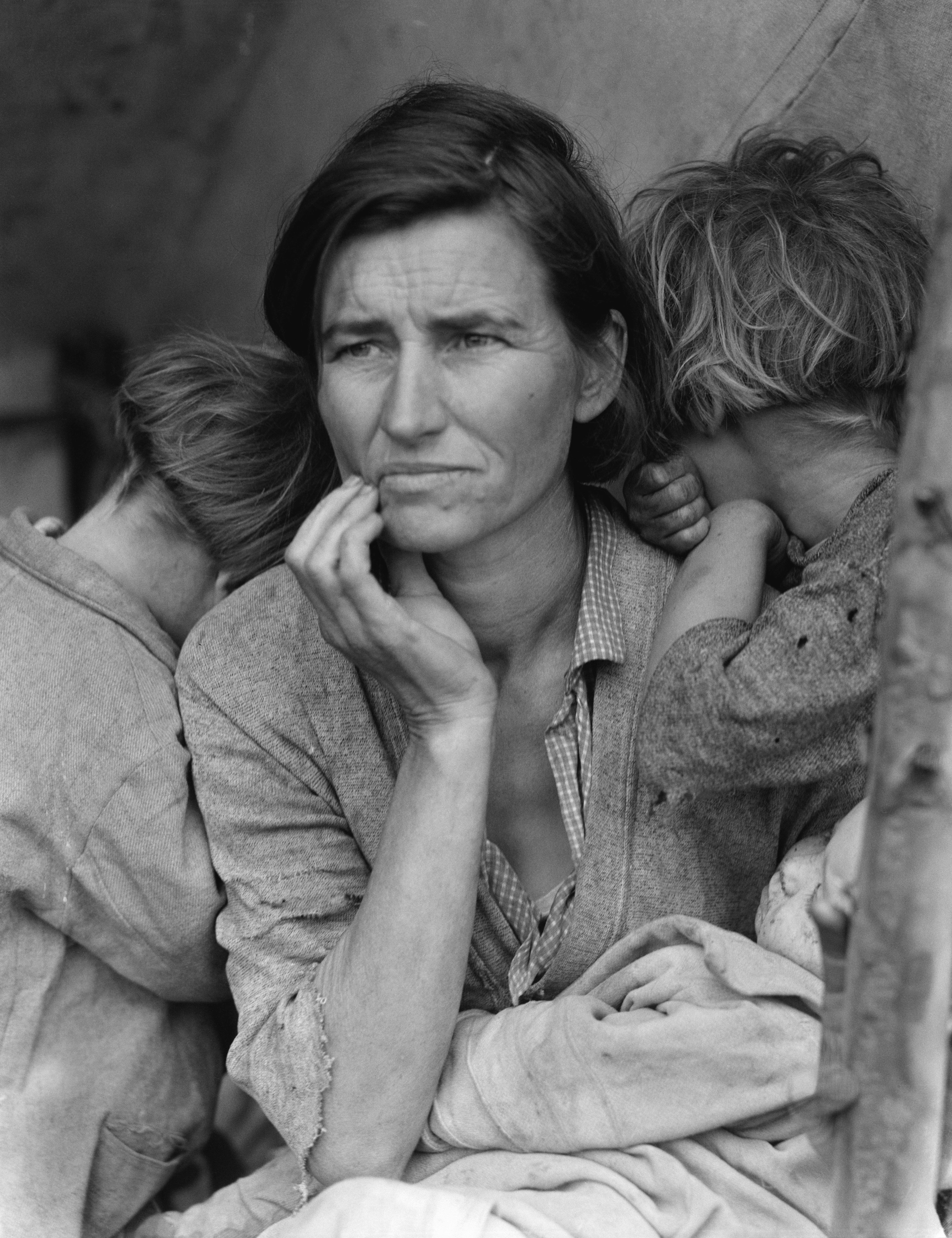
By the end of The Grapes of Wrath, the Joad family has been ground down. They’ve lost land, work, stability, even each other. They’re beaten, scattered, and displaced. Floodwaters trap them in a barn where they encounter a man dying of hunger, with his son helpless beside him. Abandoned by her husband, Rose of Sharon, who has just given birth to a stillborn child, feeds the starving man.
Rose of Sharon loosened one side of the blanket and bared her breast. “You got to,” she said. She squirmed closer and pulled his head close. “There!” she said. “There.” Her hand moved behind his head and supported it. Her fingers moved gently in his hair. She looked up and across the barn, and her lips came together and smiled mysteriously.
Steinbeck knew that intimate, taboo, deeply physical ending would scandalize. But Rose of Sharon’s act is so primal that she bypasses politics and ideology. Critics have torn into that smile for decades. Is it maternal triumph? Despair? Sacred resignation?
A single interpretation is impossible, but what matters is that the act is an image of radical sustenance and production at the edge of ruin. And absolute antithesis to the literal milk running like rivers in the rain gutters alongside the roads.
Scanlon warns that memecoin speculation + narrative platforms can hollow out real production, and society splits into Attention Harvesters vs. Real World Maintainers. Reality still has fires and floods, but capital is sucked into beliefbucks, and there’s not much capital left over for the maintainers to maintain.
On TikTok, you don’t own the factory, you don’t even own the damn machine. The platform is the factory, your phone is the machine, and your face is the raw material. The second you upload, your effort gets converted into value for TikTok—ad revenue, algorithm fuel, data harvesting. You’re building wealth you don’t control.
The product isn’t even the videos—it’s your attention. The endless thumb flick gets packaged like barrels of oil or bales of cotton. TikTok sells your compulsion to advertisers. Your focus, dopamine, and desire are ground into saleable units.
Even the biggest creator is just a person yelling at a piece of glass. Isolation is built into the system—you’re cut off from real community, from context, from people. No workplace, no team—just the eerie intimacy of performance for strangers. You’re alone in a crowd of millions.
Expression gets flattened into “content.” Creativity is stripped down by the algorithm into trends, dances, sounds, and hot takes. What could be spirit turns into snack-sized ads.
Most creators don’t see a dime. The “wage” is the dream of making money, the dangling carrot of “maybe I’ll blow up.” It’s not income, it’s hope. Hope becomes the new paycheck—fueling endless grinding for free.
Traditional workplaces at least had coworkers, teams, sometimes even a shared fight. TikTok atomizes. Every creator competes against every other. The “office” is a billion individualized feeds. Collaboration dissolves into rivalry for followers.
The conditions that should unite people—shared struggle, shared grind—instead fracture them. Nobody bands together; everyone doubles down on self-branding. Every single thing has become a fight to win attention, and we live inside a permanent cold open.
Which brings me right back to Mark Watney announcing, “I’m pretty much fucked.”
Because. We pretty much are.
Which brings me right back to how to ignite a story.
There’s an old adage that you should always begin in media res. That is, in the middle of the action.
Homer’s Iliad (8th century BCE) is the OG citation. The whole epic drops you nine years into the Trojan War—Achilles vs. Agamemnon.
Achilles’ wrath, to Greece the direful spring
Of woes unnumber’d, heavenly goddess, sing!
That wrath which hurled to Pluto’s gloomy reign
The souls of mighty chiefs untimely slain;
Whose limbs unburied on the naked shore
Devouring dogs and hungry vultures tore:
Since great Achilles and Atrides strove,
Such was the sovereign doom, and such the will of Jove!
Declare, o Muse! in what ill-fated hour
Sprung the fierce strife, from what offended power
Latona’s son a dire contagion spread,
And heap’d the camp with mountains of the dead
The king of men his reverent priest defied,
And for the king’s offence the people died.
Yeah, you’re in the middle of the war, but not the middle of any action. You instead walk through disease and corpses, and you get themes set up: pride, wrath, divine meddling, death. But there’s no Helen, no abduction backstory. No wooden horse. You get, more than anything here, scene-setting.
Horace, the Roman poet/critic, praised Homer for starting right in the middle in his Ars Poetica (around 19 BCE—a few years later, you know).
Through the Renaissance and Enlightenment, critics and rhetoricians kept pointing back to Horace as the authority. So by the time we get to neoclassical and early modern writing manuals, “don’t start at the beginning, start in the action” was canon.
19th/20th century novels start playing with slow-burn openings again, but in film—where audience patience is shorter—in medias res became gospel. Think pulp magazines, noir, and especially Hollywood screenwriting. Indiana Jones running from natives wasn’t the story in the Raiders of the Lost Ark, but it got our attention.
By the time we hit Syd Field, Robert McKee, MFA programs, “begin in media res” had hardened into workshop dogma. So we’ve been saying it since Horace, 19 BCE.
And citing examples that don’t really fit the mold but actually begin just a bit before the action starts:
-
Hamlet — Doesn’t open with Hamlet vs. Claudius. It opens with watchmen on the battlements seeing a ghost. We get dread, mood, mystery first, then the revenge engine kicks in.
-
Macbeth — The witches set the stage with a creepy riddle scene before we meet Macbeth fresh off a battle. Shakespeare lets us smell the sulfur before the match strikes.
-
The Great Gatsby — We don’t start with the car crash or Gatsby’s death. Nick sets the table with where he’s from, his father’s advice, and his role as an observer. That quiet setup makes the jazz-age frenzy sting harder.
-
To Kill a Mockingbird — Instead of launching into Tom Robinson’s trial, we start with Scout’s childhood—games, summer afternoons, Boo Radley. So when injustice comes, we feel what’s being corrupted.
-
Lord of the Rings: The Fellowship of the Ring — Doesn’t open with Frodo running from Ringwraiths. We get the Shire, Bilbo’s birthday party, Gandalf’s fireworks—life before it’s shattered. That’s why we mourn the loss.
But in media res became an expectation in American storytelling somewhere between pulp-era Hollywood and the rise of modern writing manuals.
It was not until the Internet that we began seeing openings like Walker and Weir.
“You better not never tell nobody but God. It’d kill your mammy.”
Who are the two people here? The speaker, you the reader. Also God and the mother. Four characters in one line. What’s the action? From the line, we can’t tell but we know something happened, and we’re being commanded not to tell. And can you name an emotion? For me: fear.
Weir’s is a more blatant, of course—more mature within the canon of the 21st century.
I’m pretty much fucked. That’s my considered opinion. Fucked. Six days into what should be one of the greatest two months of my life, and it’s turned into a nightmare. I don’t even know who’ll read this. I guess someone will find it eventually. Maybe a hundred years from now. For the record…I didn’t die on Sol 6. Certainly the rest of the crew thought I did, and I can’t blame them. Maybe there’ll be a day of national mourning for me, and my Wikipedia page will say, “Mark Watney is the only human being to have died on Mars.
The two people? Mark Watney and the crew. The action: Mark’s still alive. And the unstated emotion? Disbelief? Despair? Amused? All three?
There’s barely a 21st-century story that does not begin with this rule. I know, I’ve looked. The Da Vinci Code, The Fault in Our Stars, The Underground Railroad, Normal People, Nickel Boys, The Vanishing Half, Project Hail Mary, The Amazing Adventures of Kavalier & Clay, The Hunger Games, The Night Circus, Gone Girl….
What I’m saying is not much different from traditional writing craft advice:
-
Every scene needs conflict.
-
Show, don’t tell—let emotion be inferred.
-
Start with action, not static description.
But that advice is usually taught as “things to keep in mind” across the opening chapter. This is why Dickens, Shakespeare, and Homer can get away with the kind of openings they wrote because the in media res, the conflict, the showing, the action was spread across a wide berth of words. Plus, they are all dead.
The codified upgrade is that you put all three in the very first line or paragraph. Don’t wait. Don’t warm up. No throat-clearing. If you can compress conflict, action, and unstated emotion into one sentence, you’ve nailed the 21st-century opening.
Or, another way to put it, when you’re doing your TikTok video, don’t introduce yourself. Just get to it, because if the story always moves first, and you only have a minimum of three seconds to grab someone’s attention, and attention is what creates wealth, why would you 1) not start your story with a conflict, and action, and an unstated emotion, and 2) no matter who you are or what you do, why wouldn’t you have a story?
You thought I was going to miss getting the Monday Blueprint out today, but I’ve got seven whole glorious minutes to hit that send button.
If you’re not catching the reference here, I lifted that line directly from Virginia Woolf’s talk/essay/story Mr. Bennett and Mrs Brown, “But on or about December 1910, human character changed.” This is Woolf’s shorthand for a cultural and psychological rupture moving into modernism, the artistic response born by shockwaves of industrialization, war, and new science and into a world that had changed too fast and too violently for 19th-century storytelling to make sense anymore—pain, nuance, ambiguity: our interior worlds collapsed into confusion, and with that, how fiction must represent lives as well. And, in January 1983, the Internet was first turned on.
This riff feels like it needs a little Billy Joel.
For further reading, see:
-
CUNY Urban Food Policy Institute recalls how six million piglets were culled, milk dumped, and crops plowed under—even as hunger soared. It sparked national outrage, inspired the Federal Surplus Relief Corporation, and revealed the moral paradox of modern capitalist crises: abundance amid want.
-
Cultural Survival Mechanisms: In 1930s America, movie houses became sanctuaries. Even as the Depression shredded incomes and inflated studio debts, 60–80 million Americans still flocked weekly to films—gravitating toward distraction, hope, escape.
-
Structural Impact on Families & Communities: Family fragmentation soared: birth rates plunged, marriages delayed, desertions rose, and over 200,000 children roamed as vagrants. The Depression fractured social structures and eroded the intimate fabric of community life. Digital History
If you are up for some chicken or egg debate: The Decay of Lying by Oscar Wilde. The essay is a Platonic dialogue, so be prepared for weirdness. Anti-mimesis, Wilde argues, “results not merely from Life’s imitative instinct, but from the fact that the self-conscious aim of Life is to find expression, and that Art offers it certain beautiful forms through which it may realise that energy.” Uhm, in other words, it’s not just repeat of your favorite TikTok dance as much as you add your own spin; art is the skateboard, the stage, the canvas giving that raw inner energy a form to ride on so other people can see life is bursting with all the stuff it wants to say, and art is the shape that lets that scream come out in a way other people can actually see it.
A lot was going on here that I’m sweeping under the rug for my argument’s sake: Roosevelt’s New Deal, Joseph I. Breen movie decency codes that prohibited nudity, profanity, glorified crime, or adultery—man, can you imagine Game of Thrones or Breaking Bad back in the late 1930s? And, of course, World War II ultimately pulled the United States out of the Great Depression because no better way to create jobs than to go to war.
Herbert Marshall McLuhan was a Canadian philosopher whose work is among the cornerstones of the study of media theory. Yep, that guy.