Dawn gnaws at the edge of the trees, and frost has not yet left the long grasses. A dozen people, faces smeared in ash and fat, each holds a spear. Somewhere ahead, the mammoth tears up snow. Then, someone farts. Eyes narrow. Jaw clenches. He slips behind a boulder, and his body goes: Let’s dump some ballast. Back at the line, the hunt leader rolls his eyes. The second-in-command slaps his hand against the side of his face and shakes his head in disbelief. It smells, well, worse than the mammoth. Someone mutters, “Not again, Nigel.”
You laugh, but this is a real-life thing that actually happens to our bodies. And I promise, if you’re not admitting this out loud, then you’re secretly looking around for the nearest bathroom.
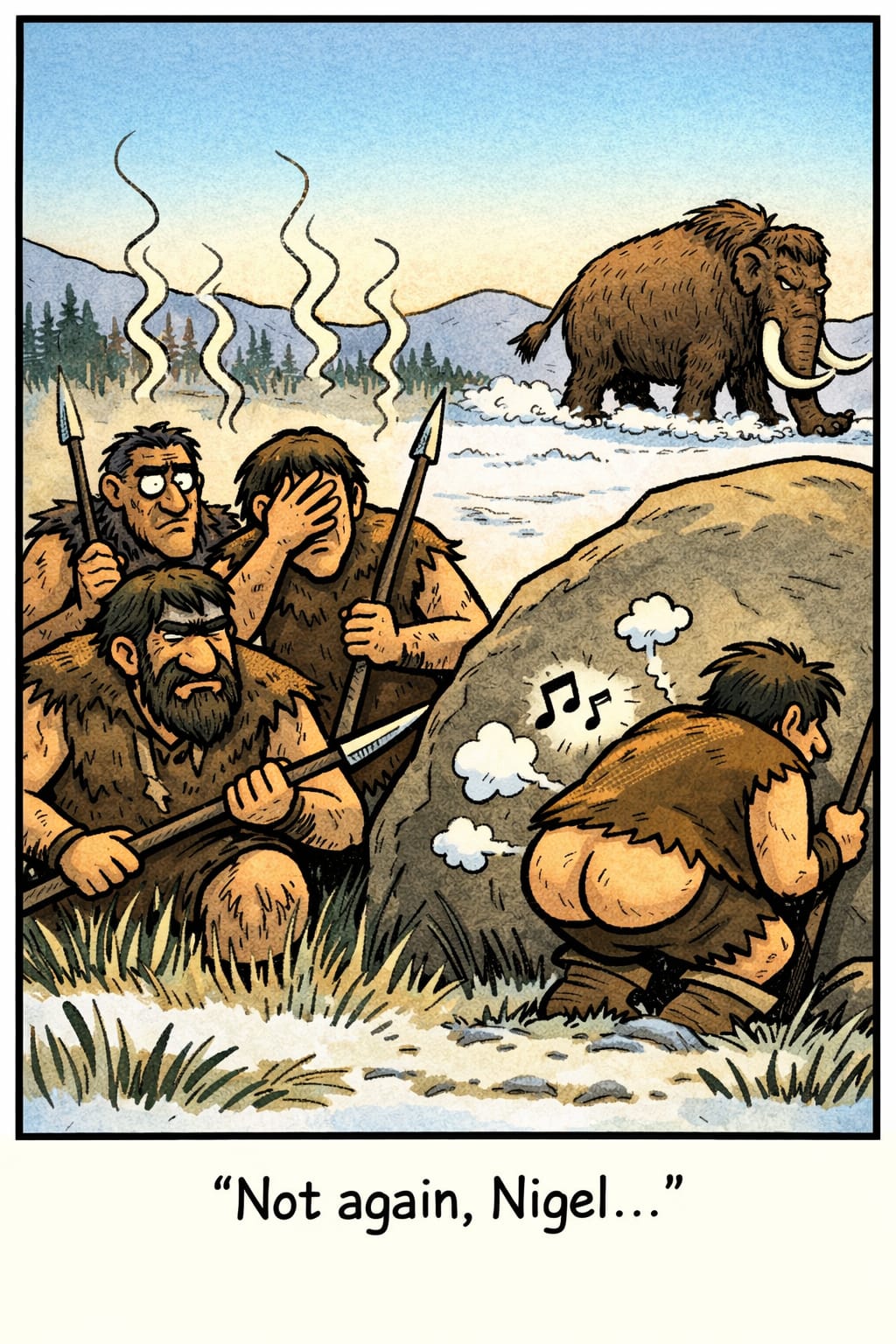
Physiologically, the hunt equals a high-stress moment plus movement. Your brain is reacting to a live-or-die survival situation. You gotta kill that mammoth, so your entire tribe can eat for the next six months. And not just your tribe, but you.
You, Nigel, need to eat.
The brain sends a message to your gut that changes intestinal motility—uhm, how fast the colon starts moving. In some people, this ramps toward minimal urgency, but also sometimes diarrhea. Exertion (running, bracing, squatting, pacing nervously) increases intra-abdominal pressure and physically jostles the intestines, helping trapped gas migrate downward until the body does the efficient thing: lighten the load.
Fast forward to the 21st century. We no longer hunt mammoths. The closest we get is when you merge into fast traffic and the car behind you rides your bumper. Or the GPS reroutes and the shortcut is a left turn across traffic with no arrow. Or maybe the cop asks, “Do you know why I stopped you?”
For the most part, our mammoth moments in the modern world center on Zoom calls, conference rooms, salary negotiations, public speaking events. But our bodies haven’t changed much since caveman days, and whether we like the situation or not, if you ever find yourself the moment before a stressful situation needing to poo, that is your mammoth moment.

I am, by the way, not a doctor. I did, however, think there was seriously something wrong with one of my upcoming real estate listings because every time I stepped into that house, the first cross off the to-do list was my mammoth moment.
Okay, honestly. At first. I thought something was wrong with me. So, as any good person does with a potential medically life-altering, event instead of visiting WebMD, I asked ChatGPT. Turns out, I Pavlov dogged myself into bowel movements.
Let me explain.
The Blueprint
Half blueprint, half confession. Irreverent. Caffeinated. Built to outlast hype.

☕A Coffee with Steve publication.

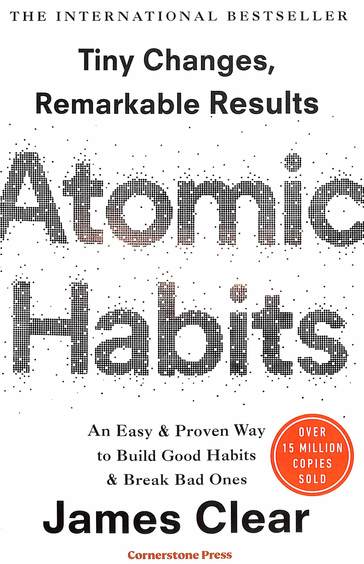
Tiny Changes, Remarkable Results
No matter your goals, Atomic Habits offers a proven framework for improving–every day. James Clear, one of the world’s leading experts on habit formation, reveals practical strategies that will teach you exactly how to form good habits, break bad ones, and master the tiny behaviors that lead to remarkable results.
If you’re having trouble changing your habits, the problem isn’t you. The problem is your system. Bad habits repeat themselves again and again not because you don’t want to change, but because you have the wrong system for change. You do not rise to the level of your goals. You fall to the level of your systems. Here, you’ll get a proven system that can take you to new heights.
Order Atomic Habits at Bookshop.org
Bookshop.org works to connect readers with independent booksellers all over the world. Local bookstores are essential community hubs that foster culture, curiosity, and a love of reading, and Bookshop.org is committed to helping them thrive. Every purchase on the site financially supports independent bookstores


James Clear argues in his book Atomic Habits that tiny habits compound into remarkable results because you fall to the level of your systems. Probably one of his most famous examples is that you need to change your intrinsic identity. So let’s say you want to lose weight, you don’t set a goal to lose weight. Instead, you get a gym membership, and you say to yourself over and over that you are the type of person who goes to the gym. Then, just go to the gym. Don’t actually work out, of course. Eventually, you’ll begin to believe you’re the type of person who goes to the gym.
The second step in Clear’s thesis is that you must make each improvement ridiculously small. So when you go to the gym, don’t spend a lot of time there. Five minutes in, five minutes out. Done. I mean, maybe side-eye the treadmill, you know. But my God, don’t actually get on the treadmill.
Then, design the environment so that good habits are easier and bad habits are harder. No one really has willpower. I have a home office because my oldest daughter moved out, and I installed a coffee maker so I’m not spending time in the kitchen.
Lastly, use a simple behavior loop: cue, craving, response, reward. And this is the point where Ivan Pavlov’s dog comes in.
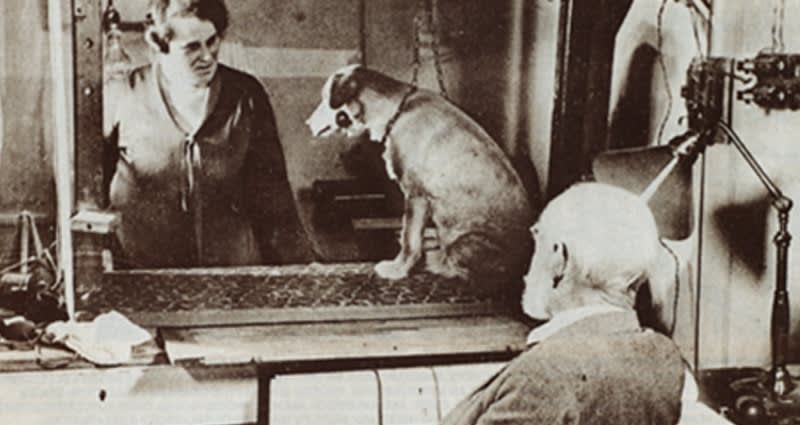
Ivan Pavlov, a Nobel Prize–winning Russian physiologist, proved that if you ring a bell every time you feed a dog, the dog will eventually hear the ding and go, “Oh, hell, yes, food,” and start drooling. That simple dog prank became the poster child for classical conditioning and helped kickstart behaviorism, and basically taught psychology that brains are just vibes.
I’ve done construction before. I grew up around my parents flipping houses. I’ve swung a mallet for day labor, hauled crumbling drywall, and rebuilt two commercial restaurants that had to pass actual health and safety inspections—like two commercial kitchens.
So yeah—one of the services I offer is light rehab and finish work, paid at closing, to get your house ready for the open market. In practical terms: if cash is tight, I come in, do the work, and you pay me when the house sells—and for seriously less than a contractor. No upfront scrambling. We just get it done, sell it right, and settle at the finish line.
The difference between the projects I did before—my parents’ flips, day-labor mallet-swinging, restaurant buildouts—was that they were either mine or they were jobs I could walk away from without caring. Low stakes.
But this house is the first time clients looked me in the eye and said, “Yeah, Steve—you do the work.” Renovation, even light renovation, is an act of taste and judgment: make this place better. That means choices and responsibility.
Plus, this wasn’t just any property but their first house, where they raised their kids, where they retreated to separate corners when they needed space, the house they kept even after moving down the street for work. When they handed me the keys, they handed me their memories.
And that’s a big damn deal, a high-stress moment plus drywall repair and paint.
The first time I pulled into the driveway, unlocked the door, and picked up my hammer, nervous as heck, I had that mammoth moment. And that happened for about the first week I was inside the house.
The second week, the moment did not pass. The third week, I wondered if I was sick or if something inside the house was making me sick.
The weirder thing: I could sit in the car in the driveway while I was sucking down the last dregs of my Dunk’s large hot with cream and be absolutely fine. It wasn’t until I opened that door, and put my first foot inside the kitchen that the sensation hit.
You know, my body is just trying to help, but still working off that ancient caveman software and no concept of “this is only drywall.” My clients handed me keys and memories, and my nervous system said, cool—this is sacred. The bowel movement becomes a dark little benediction.
The body confesses, “I understand the stakes.” 😄💩✨
Hey, if you need a Realtor, just hit the big green button, and I’ll come to your house and poop regularly, too.

“Good writing is always about things that are important to you, things that are scary to you, things that eat you up.” – John Edgar Wideman
🌐 Explore more at stevebargdill.com
Coffee With Steve is free. If you enjoyed this post, you can tell Coffee With Steve that their writing is valuable by spreading the word and sharing with a friend.
☕In Real Estate 101
Why Your Realtor Might Be In Over Their Head
The first in a full 10-part series that pulls back the curtain on an industry most people never get to see clearly. Beginning with the low barrier to entry that brings so many agents into real estate, the pieces walk readers through how those agents are actually educated, supervised, and licensed to represent the largest financial decisions of someone’s life. From there, the arc traces the full anatomy of a transaction—what a Realtor truly does, how agency law works in the real world, and why so much of the job has less to do with houses and more to do with marketing and navigating human behavior. The series also explains how agents are paid, how production numbers get misused, and how to read a Realtor’s online presence with a critical eye. The final installment gives consumers a practical set of interview questions so they can choose representation based on skill, clarity, and trust rather than chance or convenience.

About this publication.
Coffee with Steve is an independent publication by Steve Bargdill. Views are my own and do not represent Keller Williams Coastal & Lakes & Mountains Realty (“KWCLM”) or any other organization. Each Keller Williams Office is Independently Owned and Operated.
Not advice. Content is informational and educational; it is not legal, tax, or financial advice and does not guarantee results. Talk to a licensed professional who knows your situation before you act.
No agency created. Reading this does not create an agency relationship or agreement for services. Brokerage representation requires a separate written agreement with KWCLM.
Licensure. I am licensed in New Hampshire. Equal Housing Opportunity.
Wire-fraud warning. During representation by Keller Williams, you will never be asked via email to wire funds to anyone, including a title company. Do not follow email wiring instructions. Always verify by phone using a trusted number.
You can reach Keller Williams Coastal and Lakes & Mountains Realty at 603-610-8500 or Steve Bargdill directly at 603-617-6018.
Steve Bargdill | Realtor & Author | Dover • Portsmouth • Somersworth • Rochester • Seacoast NH | Licensed in NH as Stephen Bargdill Jr., with Keller Williams Coastal & Lakes & Mountains Realty.
Pronouns: he, they