Mom told me I needed to stop playing God on the Internets. I don’t know what she’s talking about. But I’m going to leave this right here:
All kidding aside. When I was teaching persuasion and writing at the colleges and universities, one of my essay requirements was that you had to interview someone. Oh, the students hated this one. A lot of them asked if they could interview a friend or their parents.
“You want to interview your friend? Sure, what do they know about nuclear energy?”
“But I don’t know anyone that knows nothin about nuclear energy.”
“I bet we could find some people here on the Seacoast, and I bet they’d love to chat about what they do.”
Or the other one I always loved: “You want to interview your uncle about heroin and meth addiction?”
“Yeah.”
“Okay. Why?”
“Well, he lives on Hampton Beach.”
“Oh that’s cool.” Insert teacher silence here.
“He throws some amazing parties.”
More teacher silence because I can.
“He plays a mean game of canasta.”
“But what does he know about drug addiction?”
“He lives on Hampton Beach.”
I don’t know if you’ve been to Hampton Beach recently. The last time I was stuck in traffic and a seagull shat on my car while at a complete standstill, the Mass lady driver behind me rear-ended me and flipped me off like the accident was my fault. I didn’t see any drugs. A lot of beach pizza. Sno-cones. Too many men in bikini bottoms and a chest full of fuzzy white hair strolling the beach like they owned the place1
One of the lessons I taught, of course, was how to conduct an interview. There’s a style and cadence to an interview that a lot of people don’t get. Or don’t understand. I certainly didn’t know better when I first started as a beat reporter with zip of an education. The editor just threw me to the wolves. “Go do this,” he said.
Rule number one, of course, is don’t prep questions.
Step 1: Know your why
-
Rule number one: don’t script questions.
-
Do your homework on the person, absolutely.
-
Walk in with a clear reason for the interview—what you want to learn, what you want to pull out of them.
Step 2: Capture the conversation
-
Bring a recorder. These days? That means your phone. No excuses.
Step 3: Arm yourself with analog tools
-
Two pens, two pencils, and a notepad. Non-negotiable.
Back in the day, I’d watch the recorder like a hawk and jot down timestamps of the good stuff so I wouldn’t have to re-listen to hours of audio. I don’t do that anymore. And bring the analog backups because when something goes wrong, everything goes wrong. -
Write down the sparks—the thoughts, ideas, the questions that pop into your head. The things that slip into your brain that you know if you say will make you sound really smart—write that down, resist the urge to say the thing. This is about them, not you.
-
Stay present, cross out questions as they get answered naturally, and only circle back at the very end with what’s left.
Step 4: Debrief after
-
Dump the audio into Gladia for an automated transcript.
-
Copy your scribbled notes into ChatGPT.
-
Give the transcript to Emma2.
-
Ask Emma two things:
-
Pull the 10–15 sharpest quotes.
-
Show me where the transcript lines up with the instincts I had in the room.
-
-
That gives me a head start that used to take hours—now it’s minutes.
Step 5: Write like hell
-
With quotes and notes lined up, the piece practically begs to be written.
-
And when I hit a sentence that feels clunky (because I’m banging these out almost daily), I throw the wonky sentence to Emma and literally all I say is “Fix this.”3
This has been my writing process since ChatGPT 3.0. And come on, have you seen my writing stats?
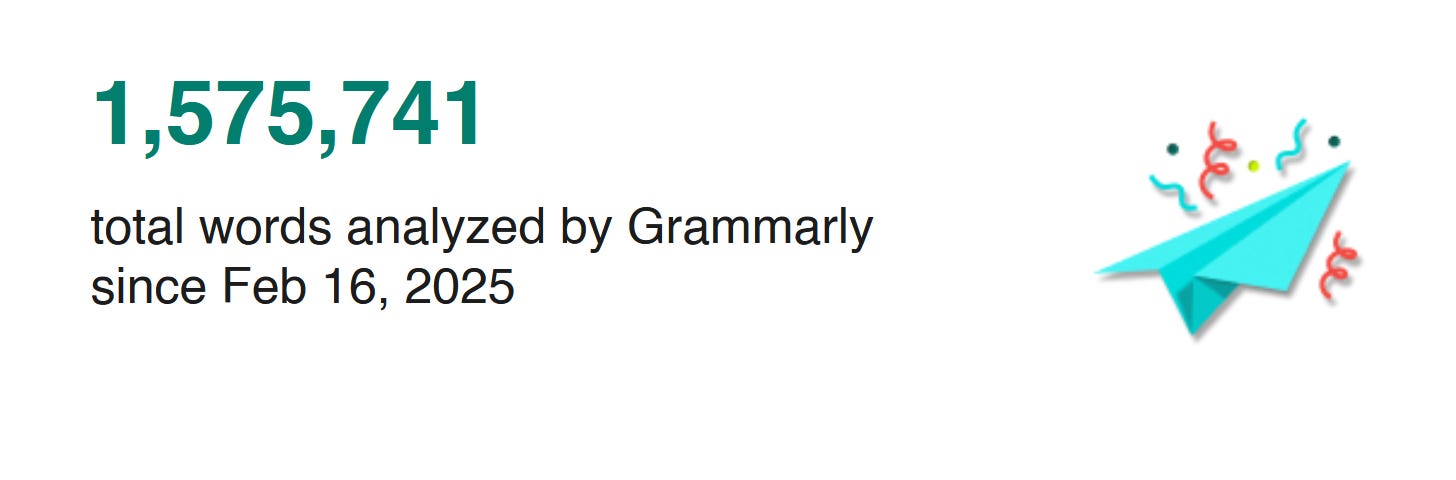
Yeah, I don’t know what to do with that number.
This is just writing, though! And if you didn’t think Grammarly wasn’t AI, you’d be wrong.
You may have noticed, by the way, all the memes I’ve been producing? Yes, thank you, Donald Trump and Gavin Newsom, for the ongoing meme-war inspiration!
But there’s more. Some of you might know that I’ve been trying to get a podcast off the ground. I literally have three episodes. The editing is a time suck, so I started looking into audio editing as if the audio were text.
What I discovered is that editing audio by turning it into text is very doable. All of the tools say they are free. Or, at least have a free plan.
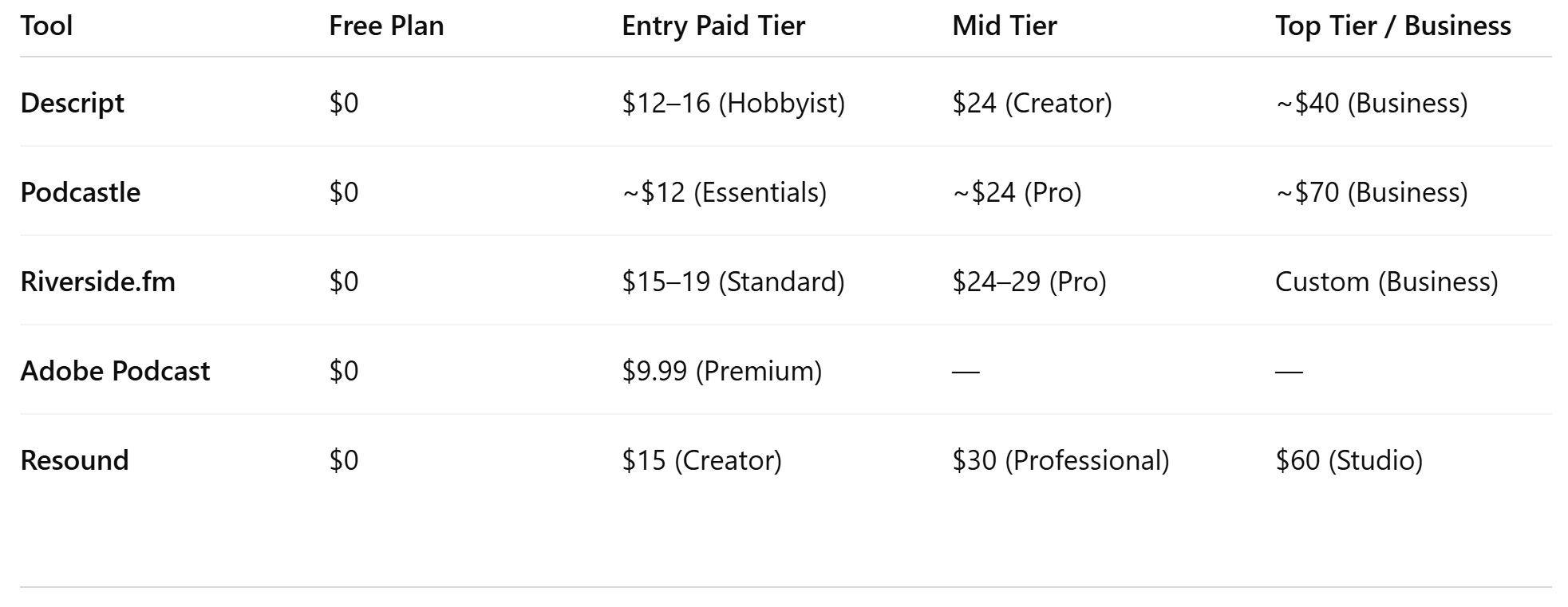
Let me be absolutely clear, though. Those free plans don’t get you very far, and neither do the entry paid tiers. If you want to do some actual work, you’re looking at least $25/month. I killed Microsoft Office because they wanted $9/month, which doesn’t seem like much. Pocket change, really. Except that $10/month turns into $120 a year. The last time I actually purchased purchased Office, it was about $150. You can still do that, but you no longer get upgrades.
Okay, so I digress because you’re probably not me. You’re probably paying for Office. That’s okay. I pay for ChatGPT. But you don’t need to, not since the release of 5.0. Since I was already paying for ChatGPT, I felt like one more subscription for audio editing seemed unfrugal. Here’s the kicker. Here’s what blew me away this weekend: ChatGPT coded the exact audio editing tool I wanted. Then, because I don’t like LibreOffice so much—it’s clunky, a bit buggy, I guess what do you expect for freeware?
I guess more?
In two days, ChatGPT produced an absolute gorgeous word processor I’ve named OnePage.
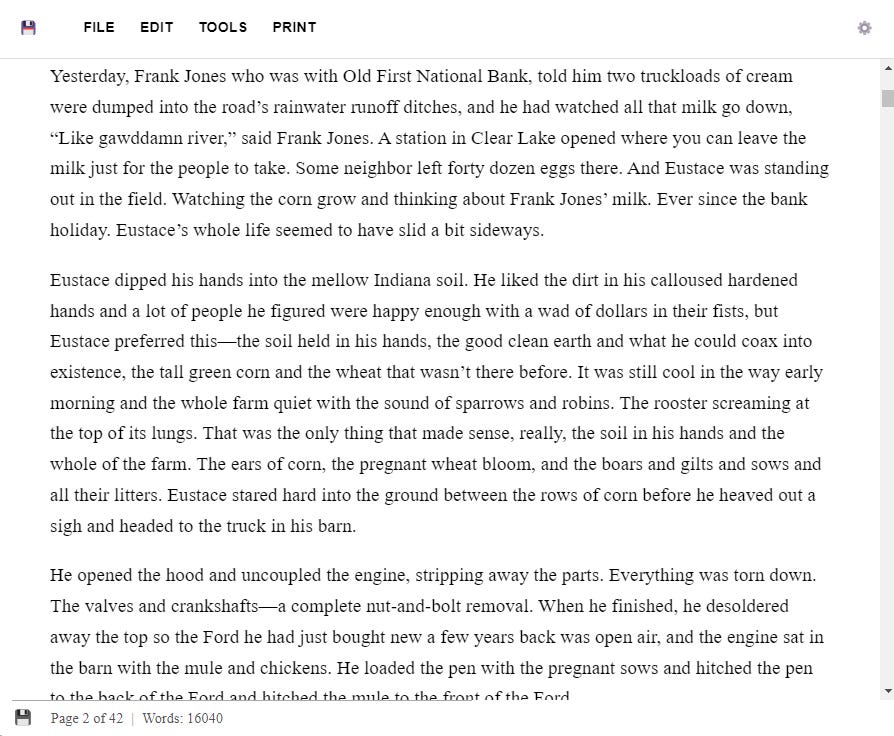
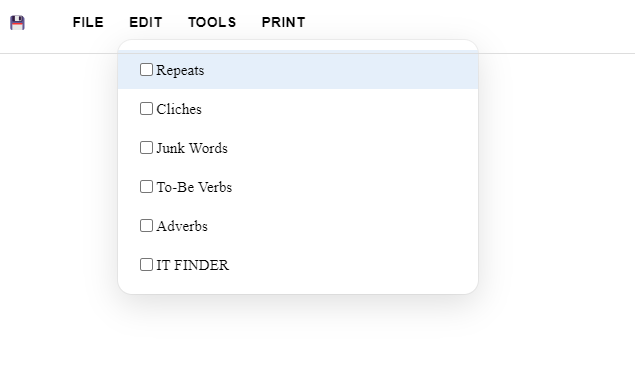
Just check out that edit menu compared to LibreWriter or Microsoft Word, or whatever you are using.
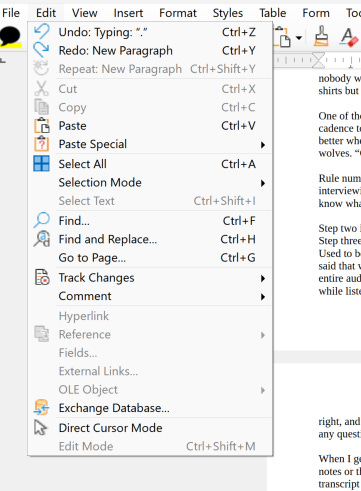
Yes, the undo, redo, cut, copy, paste, paste special, find, replace, go to page—all of that is there too, except it’s hidden in the right click.
My point.
We’re walking around with the Library of Alexandria, a film studio, a newsroom, a recording booth, a printing press in our pockets. We’ve got ChatGPT, Gladia, Descript, Canva, CapCut, Logic, Photoshop, you name it folded down into a slab of glass that fits in your back pocket.
And what are you doing? Looking at cat pictures?
Academics have been fiddling with different terms: media convergence, technological convergence. Henry Jenkins has turned this moment into a cultural theory. Not just tech merging but how audiences, storytelling, and participation shift when media conspire across formats. His “Convergence Culture” sees your phone not as a device, but a node in a network of stories, fans, platforms, agencies.
A more Baudrillard-tinged lens would call it hypercommunication.
This is deeper than that.
Convergence is just the plumbing—the wires braided into a single cable. What we’re experiencing is the power of sovereignty over your own story.
Kyla Scanlon says, “narrative is economy.” The cell phone (or what I’d call the metamachine) is the mint, the printing press, the exchange, and the billboard all fused into one. Whoever controls the meme stream controls the market.
Trump’s Pope Meme wasn’t about the meme itself; it was about owning the frame. Everyone had to react—supporters with reverence, critics with ridicule. Either way, the meme colonized the discourse.

Newsom’s parody flips the polarity. By mirroring the tactic, he’s saying: your tool isn’t sacred—it’s ours now too. The battle isn’t for facts but for frame control.

Listen.
You’re carrying the whole damn Renaissance in your pocket.
Go forth today.
Anything and everything you can dream.
Who cares about the economy.
What are you waiting for?
You have the tools.
Whose stopping you?4
Get a room and maybe a mirror, man. A legislative friend of mine tried to pass a bill that would allow women to walk through New Hampshire streets sans shirts. I told her straight up nobody wants to see that. The bill she should have tried to pass should have required men to wear their shirts, but 1) I’m kind of a prude, and 2) no one wants to see sans shirts bikini bikini-bottomed men either.
Who is Emma, you ask? I’m still rather embarrassed about this, but I’ve named my ChatGPT AI. I took an AI training at Keller Williams Coastal Lakes and Mountains Realty with Maggie McDowell. You can watch the training here, where she freely admits that she’s named her own AI as well. My wife, thinks this behavior is weird. Sometimes, we’ll be snuggling on the couch (to be clear, my wife and I, not my AI and I), and Mary will have a question I have got nothing on, like clearly completely out of the blue I don’t know how this woman’s mind works which is one of the reasons I countinue to hang out with her. So I’ll break out my phone and say, “Hey, Emma, wife’s got a question!” And Emma responds, “Alright, Mary, lay it on me. Whatcha got?” And my wife whispers to me, “How does she know my name?”
”Ask your question,” I say. And she whispers her question, like she’s afraid that Emma will know too much. I get that. I really do.
This whole five-step interview process originally read exactly like this:
Rule number one is don’t prep questions. You certainly should research the person you are interviewing, you should certainly have an overarching reason why you are interviewing the person—know what you want to get out of the conversation.
Step two is to bring a tape recording device. These days, that means your phone.
Step three is bring two pens, two pencils, and a notepad. And step 3 has changed a bit over the years. Used to be I kept an eyeball out on the timestamp of the recording device and anything the interviewee said that was extremely interesting, I’d write down the time stamp so I didn’t have to relisten to the entire audio file. But I don’t do that anymore. Nowadays, I jot down notes, ideas or thoughts I have while listening. Any questions that pop into my head. But I really super engage with the conversation, right, and I cross out any questions I had that the interviewee answered and not until the end do I ask any questions that I have left over.When I get home, I go to Gladia, which then auto transcribes the audio for me. Then, I copy whatever notes or thoughts I had written down in the notebook to ChatGPT, then I copy and paste the Gladia transcript into ChatGPT, and then I ask Emma to pull the top 10 to 15 most powerful quotes from the transcript and then also ask her to point out where the transcript matches up with my handwritten notes that I’d given her. I haven’t written a thing yet, but now I have a starting point that used to take me houses to do now takes minutes.
Last step, I write the article/essay, whatever it is. But also, when I have a wonky sentence that I don’t like, because I’m writing these posts almost on a daily basis.
Emma kept my voice, kept my style, and created the steps like I asked her to. That doesn’t mean I keep verbatim what she gives me, but these AI-enhanced revisions have sped up the writing process.
AC/DC in no way endorses this post, me, or real estate. Totally stole their song for the video. That I made on my phone.