Introduction
I wrote this story during my MFA at the University of New Hampshire. My advisor, Tom Payne, learned I’d driven OTR—over the road, long-haul trucking—and immediately begged me for a story. Not this story exactly, but some kind of truck-driving story. Any kind.
And I had a real hard time figuring out what kind of story I was going to tell about truck driving because nothing ever happened.
You just drove from point A to point B. You waited. You ate. You got yelled at. You didn’t sleep right. You stared at the sky too long. You were surrounded by people and still felt completely alone.
I don’t know what finally made me relent to Tom’s desires for a trucking story. But I do remember wanting this to be an American story. Physical, emotional. Mythic. And the hardest thing to write here was the sky. I went after the literary midwives, the authors better than me. I studied Murakami’s blue-on-blue sky, Virginia Woolf’s stiched sea and clouds. McCarthy’s Pleiades dragging all the stars away.
Then, I wrote Donner Pass.
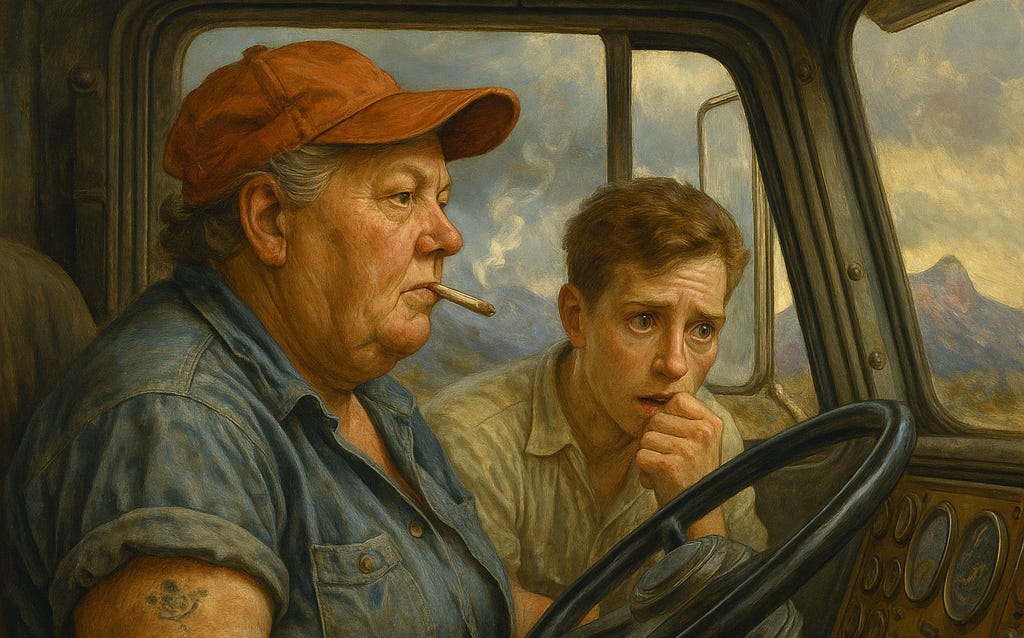
Shep slung everything he owned in a rucksack over his shoulder. An August gun-metal blue thunderstorm hunkered into the distance. Evalynne, like other veteran truck drivers he’d met: smelly, overweight, canker-sore-mouthed. And the Oquirrh Mountains—pink rose from nowhere, snow-capped crags, overburden stone laid bare. “Ain’t y the bite,” she said. She lifted him into her truck. “Welcome t my office,” she said, and “I’m on uh mission.” Shep never saw a horizon so open. No wonder people thought they’d found Zion.
She showed him where she stored the hotplate, how to turn on the TV, which side of the mini fridge belonged to him. Told him he got the bottom bunk because, “Ya ain’t ever sittin on my bed.” The recruiter promised a hefty paycheck. But Shep got paid by the mile. So far, Shep done a whole lot of waiting for an available truck and an over the road trainer, watched the company’s money tossed around on motel rooms, but no driving and no cash landing in Shep’s wallet. At twenty-six cents a mile, he figured, once he got in a truck, a six-hundred-dollar check would be lucky.
Evalynne sat sideways in the driver’s seat, elbow on her knee, hand dangling between her legs. “I got uh governor. I can’t do more than sixty unless we’re going downhill. This truck don’t stop for nuhthen. We drive as far as we can as long as we can. Ya got the night shift. Don’t wake me. As long as y drive fifty-five, we’ve got no problems. Don’t be afraid of the truck. I can’t afford y being afraid or for any gawdang trainin.” She lit a cigarette.
Shep rubbed his neck. Through the windshield, a thin gray sheen dulled the mountains. The storm edged closer and spat the occasional heavy drop. A buzzing electrical charge in the air felt through the shut doors and the closed windows pricked Shep’s arm hairs. Evalynne chewed the cigarette’s butt end. She pursed her lips. Watched him for a long moment. “Got somethen t say?”
He couldn’t back to loading docks yet.
“Jeezus,” she breathed.
Six hundred dollars, minus food and truck-stop showers, wasn’t much, but his dad laid-off from C-Pax. Thirty-two years his father worked the line to be laid off, and now he worked the morning shift at a Shell gas station part-time. They held out for so long, burning through their general savings first. Shep come home one day from Wright State University-Lake Campus, and Bank of America hung an Important/Importante photocopied Please Call foreclosure notice on the doorknob. “Don’t worry. Scam,” Dad said and curled his upper lip like Elvis. “Hubba hubba,” he said. And winked. But another bank notice arrived the next day. Mom showed him the letters they’d been receiving. Shep already turned down the scholarship to Ohio Northern so he could help with the bills: the electric in the winter, the car payments in the summer.
“Oh honey, who knows how long they’ve been sending notices.” The dark underneath her eyes deepened, and she turned her back on him, busied herself wiping Lysol and lemon clean kitchen counters. Lake Campus wasn’t even a backup plan. His instructors asked why he wasn’t attending a real school, at least Ohio State or Bowling Green, or anywhere else but. His mother spun around, forcing a smile. “Rather like those Nigerian prince emails.” She sighed. Her voice faltered. Her shoulders slumped and she stared across the kitchen to the doorway where she’d through the years carved into the jamb the angled notches marking Shep’s growth.
Shep watched Ice Road Truckers on the History channel. “I could do that,” Dad said. He pointed at the new Sony big screen covering a wall. “Well, not exactly. Not Alaska. Not driving on ice. The regular over the road stuff. OTR. The lower forty-eight, you know. The easy bit. Probably handle the mortgage.” He undid the gas station uniform’s top button and ate popcorn. “Take care a lot of things.” He slumped into the couch beside Shep.
Driving truck did seem romantic. Until Shep watched the training videos for Donner Pass. The one where the trucks fell off the edge, explosions, trailers crumpling, the dust clouds, and the dead bodies lifted out by helicopter.
Coming out of Utah on I-80 on the other side of Evantston, Wyoming, before Evalynne went to bed, she looked right into Shep’s eyes. Like she saw into his soul’s bones. “Them Three Sisters are mountains, but they seem like hills. If y aren’t watchin, y’ll pick up speed. Eighty, ninety miles an hour for sure. Hell, a hundred an twenty. Keep the truck in the right gear. If y don’t, the load will push y down. Ya push on that engine brake all day. And won’t make a gawdang difference. So keep to the right gear. And don’t be using the brakes.” She disappeared into the berth, but a hand came out and yanked on the curtain. “The right gear,” she said. And pointed at him. And shut the curtain fast; the metal clips scraped across the tension rod.
Shep held hands at nine and two and climbed the first hill. He had troubles getting the truck to go faster than forty. He worked the gears and worked the gears. Cars passed him. He saw through their windows beleaguered night drivers. They laid on their horns zooming past. Flipped on their interior lights and flipped their middle fingers in their rear windshields, their taillights angry blurring red eyes. “Noobie walking ‘er up,” chatter over the CB and “Good for you, going slow,” and “You do what you have to do,” and “low gear low gear breaker breaker.” Twenty-six cents a mile and everybody passed him, but Shep low-geared the truck, and at the first sister’s summit, the oil refinery flames burned into the night ripped across the Milky Way a crack in the firmament. The cab warm. The satellite radio turned to def comedy jam. The dashboard lights casting orange. And maybe. Maybe, he could do this.
Then descending, gaining speeds—sixty, seventy, eighty miles per hour. The governor unable to stop weight and gravity. He gripped the steering wheel. His hands sweat at the palms. He down shifted and down shifted. The load pushing him faster and faster. The momentum carried him to the second hill’s top and gravity pulled the truck into the next valley past Little America’s fifty-cent ice cream cones, past the pronghorn herds, past the long white windmills scooping stolen Wyoming wind. The truck careened around a long, wide curve. He felt the left tires lift into the air. He fought the steering wheel. He hit the Jake brake, the engine’s baritone rumble, the RPMs grinding. At the last sister’s top, Shep wiped his sweaty hands across his shirt. The jake, the careening didn’t wake Evalynne. No way to stop except to ride out to the end.
But down this last hill, he no longer spied in his mirrors the decals on the trailer’s sides. He kept her at a comfortable seventy. At the bottom, the desert gleamed underneath the starry night in pure clean hollowing winds, and he drove, adrenalin-calmed into the morning, lighting a shaky cigarette, downing coffees laced with caffeinated creamers, the sun torching in delicate purple. The landscape barren and wide swallowing him with nothing to look at except scrub cacti and billboards.
He called his dad. Shep told him how the wide open of Salt Lake almost turned him away. He’d never been so scared of the sky.
“Shep—son. We’re in an apartment. You take three steps through the living room and you’re in the kitchen. We kept the La-Z-Boy, but takes half the room.” Dad’s voice crackled over the cell. “Dropped cable. Might sell the television. Your mom don’t watch MTV anyway or Nickelodeon. The home shopping networks. We don’t need another automatic tomato slicer you remember the automatic slicer? When she ordered that slicer. It sliced those tomatoes into mush. You remember? How we all laughed? We got a little love seat, if you ever needed, I guess, you could sleep there. If you need to. But Shep, you’re doing fine. I could never imagine a mountain.”
Shep and Evalynne hauled a late October apple reefer from Washington State and snow hit after they left the warehouse. The snow mixed with sleet slivers falling wet and hard and horizontal. The headlights could not cut through the gray. They pulled to the berm. They waited, the truck, rocking back and forth, buffeted by the wind, kazooing through the windshield. Shep went to bed. Hours after the storm, Evalynne gunned it, but they weren’t going anywhere. Their wheels stuck on the freeway’s ice slurry. She told Shep to lay chains.
Shep jumped into highway traffic. The wind still blew and tugged through his pajama bottoms. He circled around the front to the storage compartment. He shoved aside the grill and the toolbox, and grabbed out the chains. He slapped the chains over his shoulder and moved against the wind. He laid the first chain and Evalynne kept gunning the truck. The tires threw loose gravel, ice bits, salt rock. He slipped and fell into the road. Evalynne still gunning, and the truck started going.
She opened the door and hollered at Shep to jump back in ‘cause she wasn’t “stoppin for nuhthen.” A tanker off the onramp jackknifed. The trailer barreling toward Shep as he ran alongside Evalynne’s truck, her screaming at him to gather the chains because chains weren’t cheap. Cars come alongside him. The tanker headed toward him. His tongue dry. His mouth salt and dirt. His breath cold in his lungs. He had nowhere to go except inside the cab. He settled into shotgun. Wet and cold. Soaked.
Evalynne cackled. “This job ain’t for the weak.”
Shep watched his fingers tremble.
They clipped full speed. The tanker seemed to have disappeared…