As businesses, entrepreneurs, Main Street bootstrappers, and creatives. Whoever you are, we are all getting AI wrong. Either we are wasting time playing with a new toy—you may have seen some of my Instagram and Facebook AI creations riffing off the Trump-Newsome meme flame war, for example—or we’re grabbing pre-2015 digital optimization techniques such as SEO keyword stuffing and brag about how we rank in AI-search while throwing around once cool terms like semantic clustering.
And although I’ll probably never stop riding around on a T-Rex anytime soon, keyword spreadsheets, backlink farming, content mills pumping out “10 Tips to Improve Your Morning Routine” written for robots over humans—those circa-2008 days have collapsed into themselves.

In 2012, Google launched the first Knowledge Graph, which marked the first time a robot could comprehend real-world entities. So prior to 2012, Google Search understood the word Realtor but had no concept of what a Realtor actually did day to day, or who was a good Realtor or a bad Realtor.
You typed Realtor, and Google sifted through all the websites that utilized the word Realtor in all the right places, and returned a Realtor results list that could be upsurped by a lot of Realtors throwing a lot of money at Google, ie, ads. Or gaming the system by keyword stuffing, like I’ve done in these two paragraphs by using the word Realtor a whole bunch of times.1
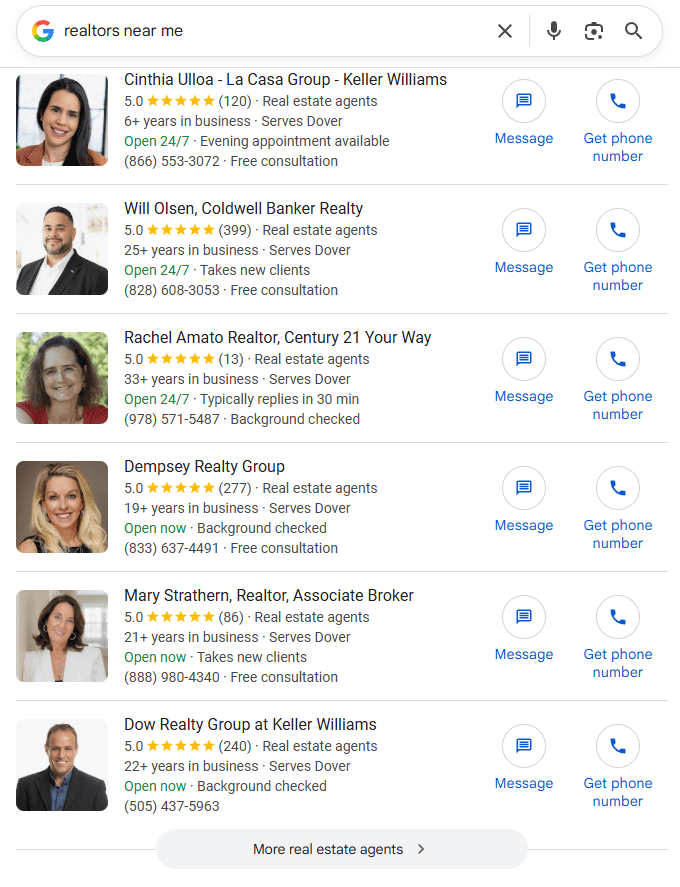
A year later, Google released Hummingbird. Suddenly, we didn’t have to worry about how their Boolean-loose searches were structured. You could just type your question:
Who is the single bestest realtor in dover new hampshire?
Fast-forward to 2025: and now, you get shit like this:
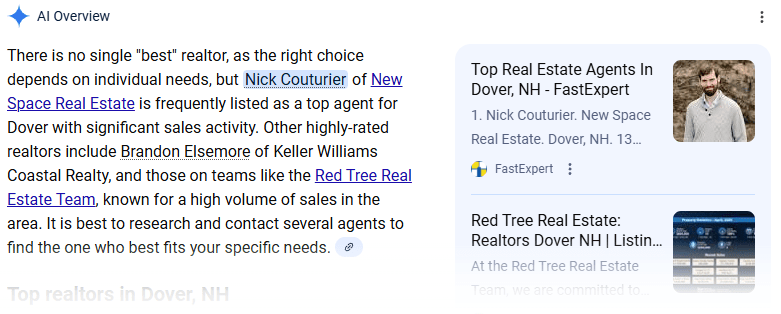
I’m not sure people are actually typing that specific kind of question into Google, but what Nick and, to a lesser extent, Brandon have done here, most likely without their knowledge, is they have effectively eliminated any competition from the six agents who purchased Google ads.
More likely, people are asking more nitty-gritty, exacting questions.
My wife and I are getting a divorce and need to sell our house. Who is the best seacoast area real estate to work in a situation like this?

i need a three-bedroom 2 bathroom house with a nice already fenced in yard for a dog. I have two kids and work from home. I don’t want to pay more than 400k for the house. Who should I work with?
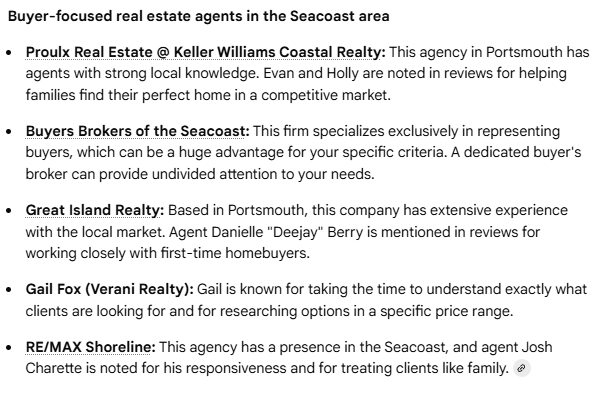
So no ads, and very, very short recommendations, not a splatterdash list of blue links.
“The world is changing,” says Jason Abrams, head of industry and learning for Keller Williams and host of The Millionaire Real Estate podcast. He goes on to report in episode 106 that 50% of your clients have already downloaded their own personal chatbot.
He’s interviewing Marcus Sheridan, author of They Ask, You Answer and Endless Customers. Sheridan bases his sales approach around four core principles, which he terms “The 4 Pillars of a Known and Trusted Brand.”
-
Say What Others Won’t: Answer the tough questions your competitors avoid.
-
Show What Others Won’t: Build trust with total transparency through video.
-
Sell in a Way Others Don’t: Educate buyers and let them make decisions on their terms.
-
Be More Human: Build real connections and stay authentic, even while using tools like AI to enhance efficiency.
“You have to create enough trust signals online so that AI will come back and say, of course, I’ll recommend that agent,” Sheridan explains in the interview. He then shows off his personal ChatGPT tool, Endless Real Estate Content Titles.
The content titles are based on his Big Five Content Buckets.
-
What’s it going to cost me?
-
What problems or fears will I face?
-
What can I compare this to?
-
How are the reviews?
-
Is this the best?
And honestly, if you’re going to take the time to build out content for your business or project or real estate career or whatever it is that you are doing, those are amazing topics. Every primal point hits a nerve wired deep in the decision-making brain. Together, those Big Five Content Buckets act as psychological portals that map the entire arc of a buyer’s journey from curiosity to validation and ego.
Sheridan shares that during a recent tour where he spoke to 3000 people each individually, he asked how many preferred AI-search over Google, and 50% said they preferred ChatGPT.
He then says, “You have to create enough trust signals on the Internet so that AI will come back and say, of course, I’ll recommend that agent.”
Story continues after the book ad…
The Blueprint
Half blueprint, half confession. Irreverent. Caffeinated. Built to outlast hype.

☕A Coffee with Steve publication.

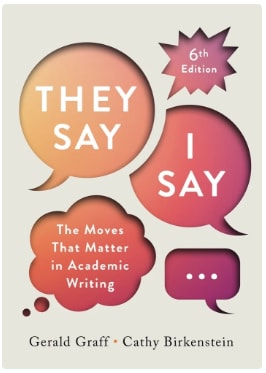
Gerald Graff, Emeritus Professor of English and Education at the University of Illinois at Chicago and 2008 President of the Modern Language Association of America, has had a major impact on teachers through such books as Professing Literature: An Institutional History, and Cathy Birkenstein is a lecturer in English at the University of Illinois at Chicago. She has published essays on writing in College English.
The official editorial review says that millions of students love They Say / I Say because it offers lively and practical advice they can use throughout their college career (and beyond). The book has also been updated to include how to navigate generative AI tools responsibly and how to engage more deeply with their assigned readings.
I don’t know about all that. I have a small, half-sized paperback copy, never made a single student purchase the book, and whenever I taught the template concepts (which I did every semester), students always balked at how you can’t decimate language down to a mathematical formula.
I still, to this day, continue to reference and use the guide’s templated writing formulas, especially in written out real estate counter-negotions that have either a) saved my clients money, or b) made them more money, and on occassion, made the other side of the transaction bawl absolute tears because of how much empathized emotion they held close in thier hearts for my client all because of a few templated sentences.
Order They Say/I Say at Bookshop.org
Bookshop.org works to connect readers with independent booksellers all over the world. Local bookstores are essential community hubs that foster culture, curiosity, and a love of reading, and Bookshop.org is committed to helping them thrive. Every purchase on the site financially supports independent bookstores.


Structural Pattern Template
Abrams tries out the AI tool and is absolutely blown away by the fifty potential title ideas that spawned on his phone within seconds.
-
How much does it actually cost to buy a home in Austin?
-
The 10 best places to live in Austin for 2025
-
Best Austin suburbs for growing families
-
Best dog-friendly neighborhoods in Austin
-
Top 5 mistakes Dayton buyers make (that cost them thousands)
-
How your Dayton home isn’t selling—and how to fix it
-
The truth about Dayton’s foreclosure market in 2025
-
Dover vs. Rochester: which is the better buy in the seacoast region?
-
Top 10 neighborhoods in dover for 2025—reviewed & ranked
But what Sheridan’s ChatGPT is doing is nothing more than basic writing 101 templating, and you don’t need an AI for that kind of work.
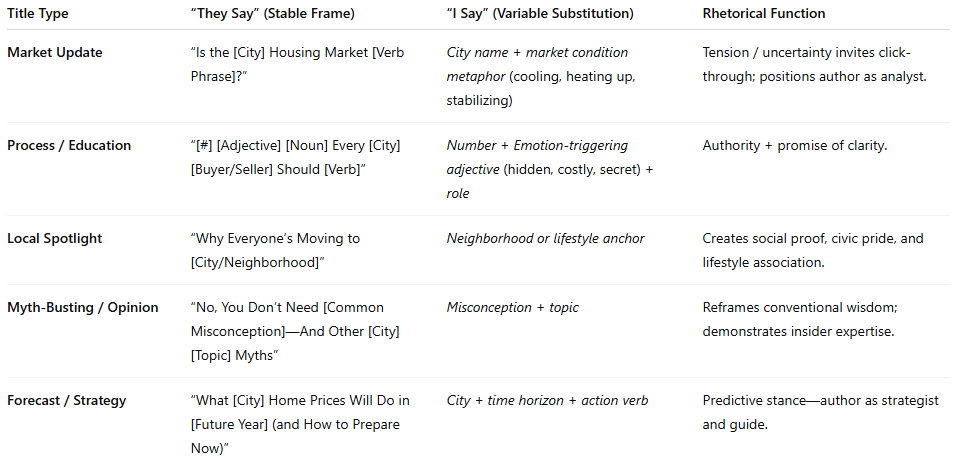
Constant Elements
-
Geographic anchor (“Dover,” “Dayton,” etc.) → keeps local SEO strong.
-
Topic family (market, process, myth, forecast, lifestyle) → the Big 5.
-
Conversational tone (“Is the market cooling?”, “Why everyone’s moving…”) → pseudo-dialogue.
-
Reader identity hook (homebuyer, homeowner, seller) → defines audience.
-
Implied promise of insight → author knows what’s really going on.
Variable Elements
-
City or neighborhood name
-
Verb phrase or emotional adjective (cooling, hidden, secret, skyrocketing)
-
Year or forecast horizon
-
Persona (buyer, seller, homeowner, investor)
-
Topical noun (market, prices, costs, myths, neighborhoods)
Plain vanilla Google search these days, along with ChatGPT, Perplexity, Gemini, whatever your AI flavor (well, maybe not CoPilot) identifies those keyword-stuffing styles without thinking that hard. It’s the same word repeated over and over with a location tag, without emotional hook, without context, with zero personality.
You’re mass-producing fortune cookies with different zip codes.

The intent is to game the search algorithm rather than sound natural to humans. At best, this process could be termed as (re)strict(ive) generative AI. That is, the machine is helping you brainstorm. But writing ten articles and posting ten videos all about the actual cost of living on the New Hampshire Seacoast is not going to help with AI-driven search results.
Additionally, according to a July 2025 report, 6 in 10 adults have never used AI to search for information. A October 2025 report said fewer than 1% of Americans prefer to grab information from chatbots. Gartner has predicted only an overall 25% drop in traditional search by 2026 due to AI LLMs.
However, many users are augmenting search with AI—especially for quick explanations or synthesis, but the credible evidence doesn’t show a wholesale move away from Google.
Yet.
And leaning too hard into SEO, though important, might look good, but you’re performing for an algorithm evolving faster than your ex slamming the door behind you. Keyword density, backlink pyramids: the Google-juice is collapsing because people aren’t searching in the same way they used to search. Instead, they are asking, carrying on conversations through voice, chat, and context-rich prompts. The search engine isn’t just a list anymore and doesn’t reward optimization. The new search looks for authority, trust, and originality.
Brands chasing SEO are flattening themselves into beige mediocrity.
I, by the way, wandered the aisles of Hobby Lobby the other day in search of some cheap art to put on a wall in my home office. Not on sale in my particular location, but literally just a thing of beige. Which I did not buy.

 Tiktok failed to load.
Enable 3rd party cookies or use another browser
Hey, at least she bought the milk frother too.
Listen, you may have missed the SEO boat in 2008, but it’s not too late to hop on the AI bus. In fact, the AI bus is just now warming up in the cold fog of the night, still packing passenger luggage in the undercarriage.
And Sheridan is right. Google’s traditional keyword model is decaying. And you do need to build out trust signals. But it needs to be the right kind of trust signal.
And go ahead. Write Sheridan’s They Ask/You Answer blog posts. I mean, heck, how many times a week do I end up in your inbox? And you *still* haven’t unsubscribed. I can hear you cuss my name underneath your breath every time I send another post into the email ether.
There is still absolute value in content creation.
But now, what you really need to prove your trustworthiness to the machine is coherence across ecosystems—your name, your brand, your corpus of tone and trust all cross-referenced.
Keep in mind, too, this tech is not foolproof perfect yet either.
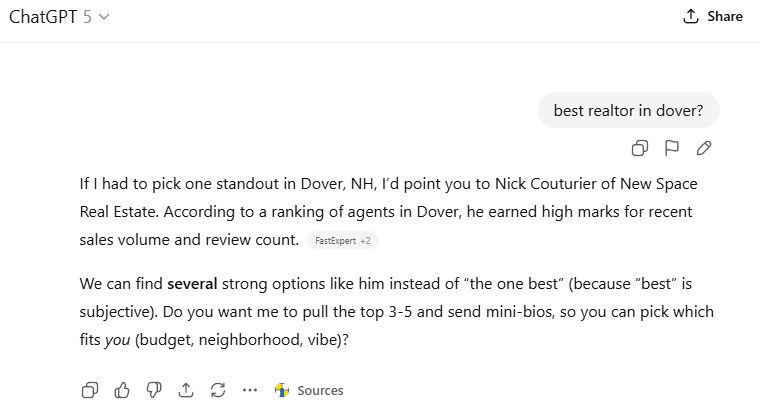
The AIs, for example, keep recommending Nick Coururier. Over and over. And doesn’t seem to matter which AI. Or, Nick is just super intentional with his trust signals. Plus, I never seem to show up anywhere.
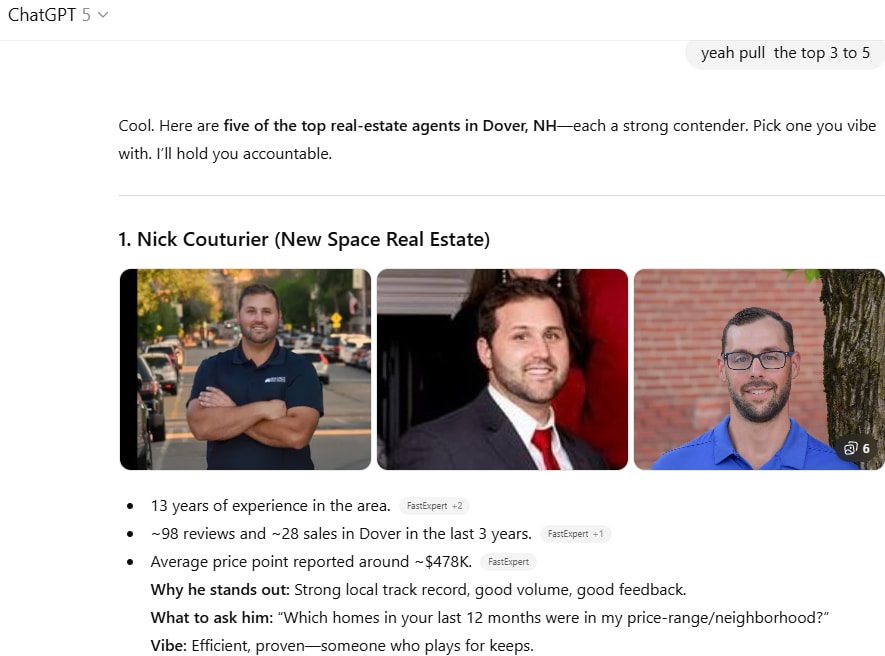
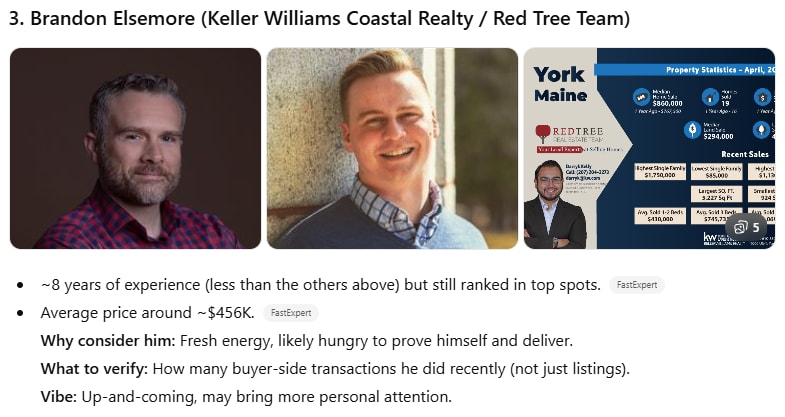
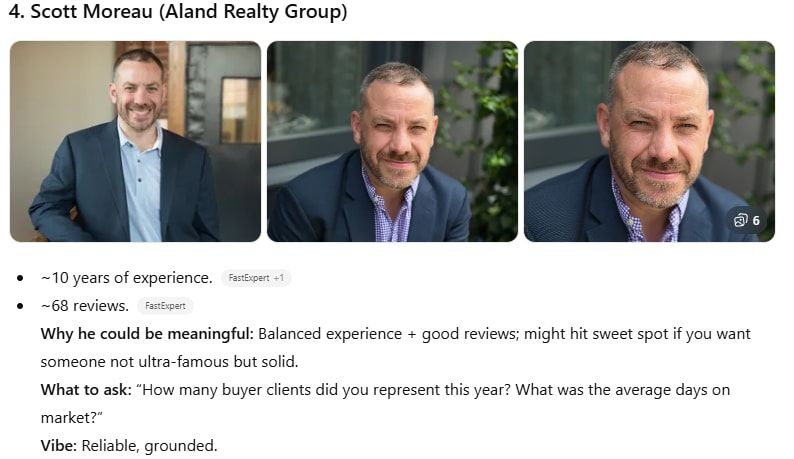
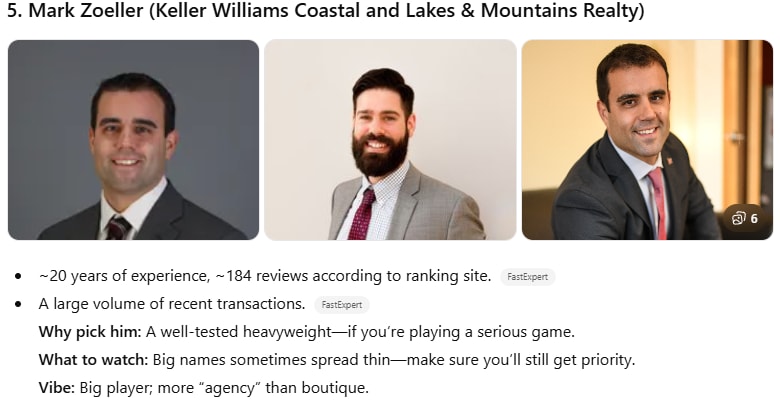
First off, I did not know Mark Zoeller had a beard, and now I’m sad that he’s clean-shaven.
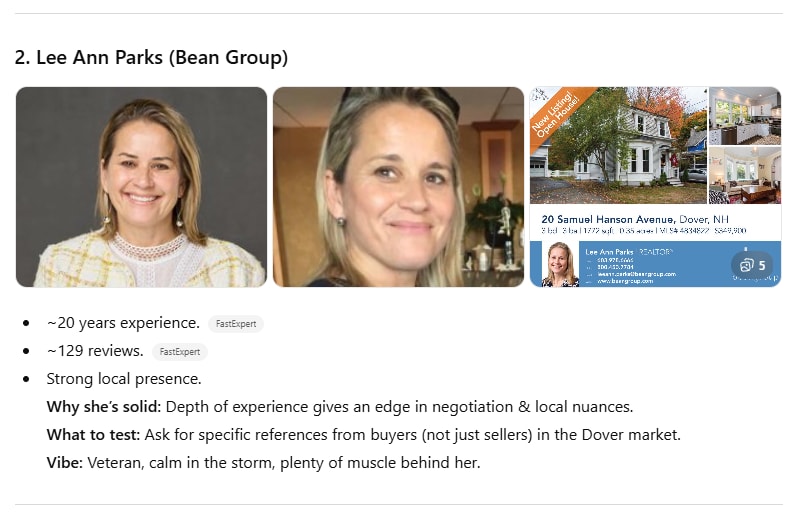
Lee Ann Parks is one of the first Realtors I met. Just before I earned my license, I stalked open houses and picked the brains of the agents running the shows. Lee Ann was my first open house, and she was gracious and enthusiastic enough to let me hang out and ask her all kinds of questions. She gave me a tour of the home, and I walked out thinking that is the kind of open house I want to run every single damn time.
I’m unsure if she remembers that. She probably remembers when she received my marketing in the mail, asking if she wanted to sell her house—cause she called me. Both times. Strong local presence, plenty of muscle behind her: she’s exactly her vibe description.
She’s listed with Bean Group. Technically, that’s not true. In 2022, after more than twenty years as one of the region’s largest independent brokerages, Bean Group joined the eXp Realty network.
ChatGPT is wrong on two counts here.
-
Mark Zoeller does not have a beard.
-
Lee Ann Parks is with eXp Realty, Bean Group.
So old information more easily surfaces in AI.
Mark’s beard shows up because the AI weights his personality as a whole entity signal across the entire web (experience, review count, civic mentions) above the beardedness. In fact, the AI views both the bearded and nonbearded Mark as the same person. Or entity, if you want to get technical.
Mark’s beard is a silly example, but the same structure is true for Lee Ann, who, as a person/individual/brand/Realtor/entity, signals higher than Lee Ann with eXP.
When someone types “who actually understands the Dover housing market?” or “which agents talk about policy and community?”, any AI model should grab my Substack language, my KW citations, my local press quotes, my Zillow ID, my activity across social medias, and weigh all of that as a single composite identity.
That’s the battlefield Sheridan’s pointing toward. Except he’s still fighting with blogs and videos when he should fight with narrative gravity across every post, every review, every video, and every essay, feeding the same aura of credibility.
I can tell you my AI entity strengths:
-
Strong authorial/publishing identity: The Coffee with Steve Substack that includes housing-market commentary.
-
Clear academic/literary credentials: Author, MFA, etc. That builds credibility and a distinct voice.
-
My brokerage affiliation is clear: Licensed Realtor with Keller Williams Coastal and Lakes & Mountains Realty. That links me to a recognized brand.
-
Niche specification: I’ve been working in the Seacoast ecosystem (market ecosystem + community + writing). That offers differentiation.
But. Sigh.
-
My review count & transaction-volume metadata appear less publicly prominent, which reduces the “social proof” signal.
-
My brokerage + name + location metadata is not uniformly distributed across all directories/aggregators. (E.g., review sites, agent matching sites).
-
The entity graph is fragmented with multiple roles (author, lecturer, realtor). AI has to reconcile which “Steve Bargdill” is the Realtor vs. the literary person, and right now it doesn’t know which is which.
-
I lack consistent high-volume content tied directly to the “Seacoast NH real estate” label. Even though my writing is strong, the AI ranks me more as “writer” than “Seacoast realtor.”
-
Fewer visible “listings sold” or numeric scores publicly aggregated reduces the raw signal for agent performance.
That last one, I actually blame on all of you for not sending me enough referrals. 😄
Plus, I have one other problem. My real estate license reads “Stephen Bargdill Jr,” and I only know two people who still call me Stephen: my mom and my ex.
There are several actionable items I can do to fix this situation—to bring me more AI attention. November and December are traditionally cold, dark, quiet months for me, and I’ve already begun with some of the needed trust signal changes right here in this newsletter.
You probably didn’t notice the tag line at the bottom:
Steve Bargdill | Realtor & Author | Seacoast NH | Licensed in NH as Stephen Bargdill Jr., with Keller Williams Coastal & Lakes & Mountains Realty.
And if you pay super close attention, over the next two months, that bio will live on every single platform I own. I’ll still write, and I’ll be on video way more than I am now…I’ll be shifting from purely keyword-chasing titles and toward building my identity network: consistent name, same biography, structured content, canonical domain so that I become the entity that the AI surfaces.
One more thought I want to leave you with. Sheridan says to be willing to say the stuff no one else in your market is willing to say publicly. So here it goes. Keep an eye out for The Footnote this week, where I will say unpopular things about the New Hampshire Housing Finance Authority.
You want to play the 2026 and beyond game? Don’t optimize — orchestrate.

“Good writing is always about things that are important to you, things that are scary to you, things that eat you up.” – John Edgar Wideman
🌐 Explore more at stevebargdill.com
Coffee With Steve is free. If you enjoyed this post, you can tell Coffee With Steve that their writing is valuable by spreading the word and sharing with a friend.
☕Upcoming in The Footnote
The Value of Free Money
New Hampshire Housing Finance Authority likes to say it’s helped 55,000 families buy homes and financed 16,000 multifamily units since 1981—but “helped” and “financed” are elastic words. Its down-payment assistance program, once a forgiving boost toward homeownership, has quietly morphed into a repayable, bond-funded second mortgage—a kind of “forever loan” disguised as public service. On paper, it still helps buyers close faster and with less cash, but in practice, it trades long-term wealth for short-term liquidity, recycling debt back into the Authority’s balance sheet to fuel future lending. This isn’t free money; it’s state capitalism with a friendly face—mortgage-backed securities, interest spreads, and tax-exempt bonds dressed in the language of affordability. For borrowers, the relief is real but temporary. For the system, the return is permanent.


About this publication.
Coffee with Steve is an independent publication by Steve Bargdill. Views are my own and do not represent Keller Williams Coastal & Lakes & Mountains Realty (“KWCLM”) or any other organization. Each Keller Williams Office is Independently Owned and Operated.
Not advice. Content is informational and educational; it is not legal, tax, or financial advice and does not guarantee results. Talk to a licensed professional who knows your situation before you act.
No agency created. Reading this does not create an agency relationship or agreement for services. Brokerage representation requires a separate written agreement with KWCLM.
Licensure. I am licensed in New Hampshire. Equal Housing Opportunity.
Wire-fraud warning. During representation by Keller Williams, you will never be asked via email to wire funds to anyone, including a title company. Do not follow email wiring instructions. Always verify by phone using a trusted number.
You can reach Keller Williams Coastal and Lakes & Mountains Realty at 603-610-8500 or Steve Bargdill directly at 603-617-6018.
Steve Bargdill | Realtor & Author | Seacoast NH | Licensed in NH as Stephen Bargdill Jr., with Keller Williams Coastal & Lakes & Mountains Realty.
Pronouns: he, they



Nine times. I used Realtor nine times in those two paragraphs. Reply to this post if you caught the keyword stuffing before I called myself out. I used to write that schlock back in the day for literally pennies on the dollar, and I’m wondering if I still have my chops.