I’m not sure if my wife knows, but I kinda have a thing for Andie MacDowell. If our marriage included hall pass list allowances, MacDowell sits at the very top of mine.
Bill Murray, on the other hand, is probably the ugliest-looking person I’ve ever seen. Great actor, of course, and oddly, as he’s continued to age, he does keep getting better looking. It’s almost as if his skin was born to be an old man.
I’m no body-shaming John Oliver, but my point is, MacDowell and Murray are an odd casting choice for Groundhog Day.
Groundhog Day is somewhat of a tradition in our house, much like It’s a Wonderful Life is the movie we watch almost every Black Friday. I don’t think anyone hasn’t seen It’s a Wonderful Life, but I continue to run into a few people who haven’t seen Groundhog Day, and if you’re not familiar with the film, Murray plays Phil Connors, a Pittsburgh TV weatherman.
Phil thinks he’s smart, superior, untouchable. He’s sarcastic, impatient, allergic to sincerity. He believes the world is something to be endured, not engaged. Basically, he’s an ass. MacDowell plays Rita Hanson, Phil’s behind-the-scenes producer. The two do not like each other.
And then the universe snaps. Phil wakes up on February 2nd.
And again.
And again.
Same town. Same people. No consequences. No witnesses. No escape.

The film then walks us through four distinct phases: hedonism, control, despair, and surrender. We watch Phil stuff an entire piece of cake into his mouth at once. We watch him trick Nancy into bed by memorizing everything about her. On-screen suicide attempts are at six, with at least four more implied. The actual number is uncountable.
In that early-loop breakfast scene at the bed and breakfast, Phil begins to super-fixate on Rita. He speaks to her as if continuity already existed between them.
“You know, yesterday you said…”
“You really are something.”
This is casual warmth that assumes shared time.
For a 90s film, Hollywood is doing some quietly boundary-breaking messaging because Groundhog Day is quietly, ruthlessly anti-capitalist.
The Blueprint
Half blueprint, half confession. Irreverent. Caffeinated. Built to outlast hype.

☕A Coffee with Steve publication.

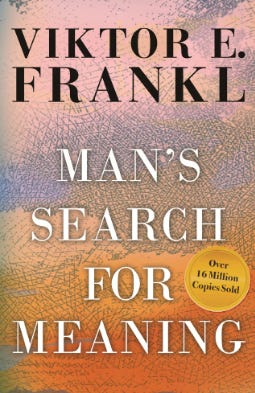
This seminal book, which has been called “one of the outstanding contributions to psychological thought” by Carl Rogers and “one of the great books of our time” by Harold Kushner, has been translated into more than fifty languages and sold over sixteen million copies. “An enduring work of survival literature,” according to the New York Times, Viktor Frankl’s riveting account of his time in the Nazi concentration camps, and his insightful exploration of the human will to find meaning in spite of the worst adversity, has offered solace and guidance to generations of readers since it was first published in 1946. At the heart of Frankl’s theory of logotherapy (from the Greek word for “meaning”) is a conviction that the primary human drive is not pleasure, as Freud maintained, but rather the discovery and pursuit of what the individual finds meaningful. Today, as new generations face new challenges and an ever more complex and uncertain world, Frankl’s classic work continues to inspire us all to find significance in the very act of living, in spite of all obstacles.
Order Man’s Search For Meaning at Bookshop.org
Bookshop.org works to connect readers with independent booksellers all over the world. Local bookstores are essential community hubs that foster culture, curiosity, and a love of reading, and Bookshop.org is committed to helping them thrive. Every purchase on the site financially supports independent bookstores


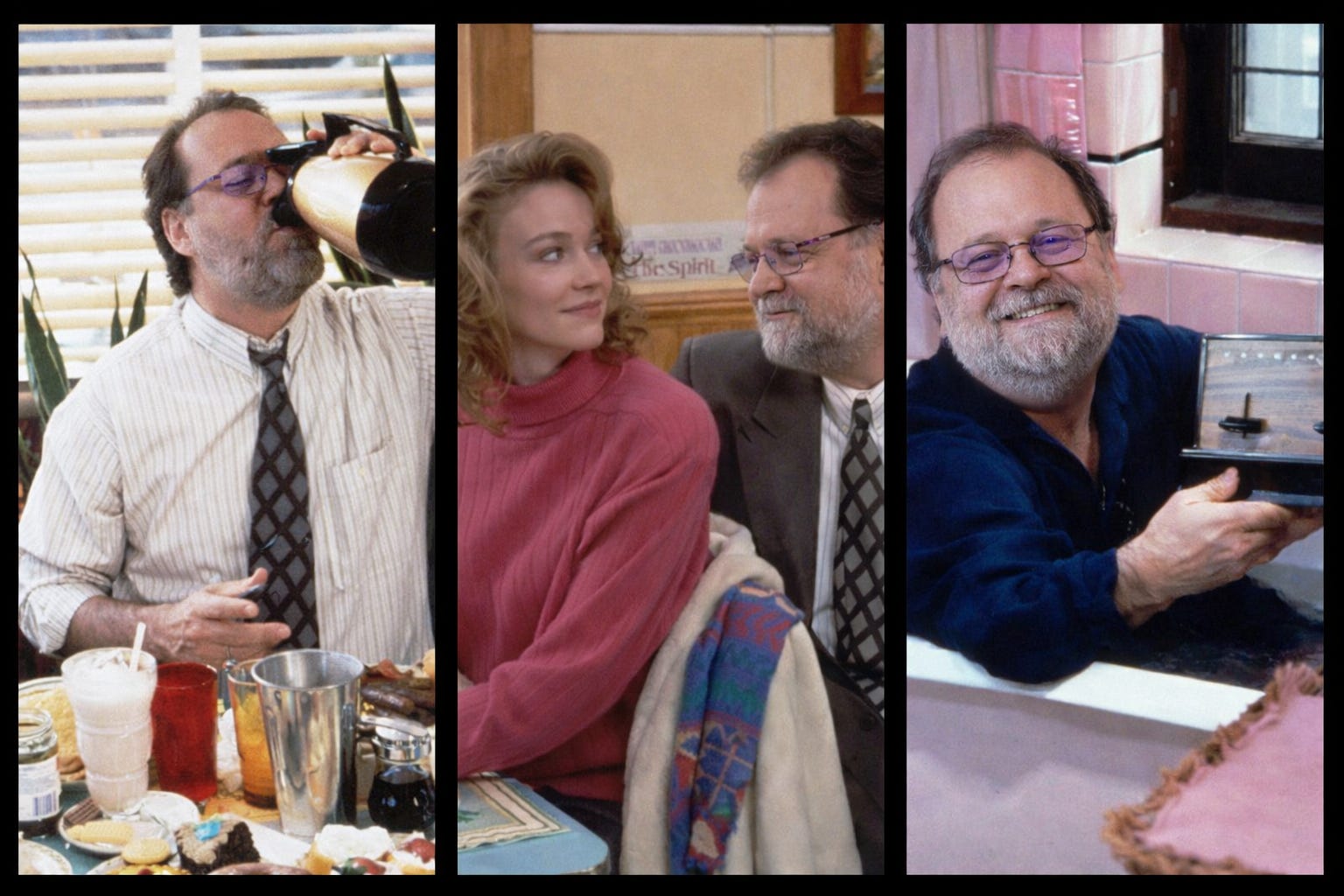
Capitalism operates on three core assumptions that are locally and instrumentally true: time is money, progress is linear, value comes from extraction, efficiency, and accumulation. The film obliterates all three. At the beginning of the film, Phil’s entire identity is built on leverage: career status, charm as currency (though I’d argue he’s not really all that charming), and time as something to spend.
But the loop destroys scarcity.
Tomorrow never comes. Time, money, information, and resources are unlimited. There is no promotion. No bonus. Nothing to hustle or grind for. Money collapses as a motivator. Achievement loses purpose. All that remains is unadorned existence.
So if you’re still thinking inside a capitalist mindset, where success is defined by external signals, but you wake in a world where none of those traditional inputs produce predictable outcomes, your first instinct is to scramble for meaning that still appears to originate outside yourself. For Phil, that meaning takes the form of Rita.
In 1990s Hollywood, women were largely framed as endgame products: something to be earned, something that validates growth, or something that proves redemption works. Dorothy is Jerry Maguire’s gold star for learning to care. For Carol, as good as it gets for her means she’s the payoff for Melvin’s incremental decency. Pretty Woman Vivian allows Edward to preserve his systems, his values, and his power, outsourcing transformation to the purchase of better feelings. Adrian doesn’t choose Rocky, but is silent, grateful, and won. An award for persistence. Jenny is punished for autonomy and is only safe once she’s completely broken both body and spirit, when she is no longer an emotional threat to Forest Gump; Forrest doesn’t grow toward her, he simply waits. And when women do have subjectivity, the culture panics—and straight-out destroys Thelma and Louise, driving them off a literal cliff.

Structurally, the audience expects Rita’s existence to prove the male transformational arc worked for Phil. But Rita is radical because she does not comply with the archetype she’s written into.
Rita does not exist for Phil, but solely exists for Rita. She is the film’s steadfast, unflinching moral anchor.
Returning to that early breakfast scene, notice Rita is already home in that space. She chats with other guests, she’s warm, she listens more than she performs. When Phil finally enters the room, Rita doesn’t orient toward him, and he must insert himself into the already existing social ecosystem. Because Rita does not wait to be activated by the male lead, this scene firmly establishes her as socially sovereign.
At dinner, she reads and eats alone. Rita is framed as self-contained. The camera doesn’t justify her solitude. Phil’s first blizzard night with Rita, where the audience expects the woman softening toward advances trope, she maintains eye contact and invites conversation. Except when Phil performs rather than naturally inhabiting intimacy, she enforces limits without drama or apology, simply by leaving. When she finally decides to stay the night, she experiences Phil not as performative but as fully present within a non-instrumental, immanent, lived-phenomenological moment. And you could argue Phil has won her in much the same way as Jerry Maguire’s Dorothy or Melvin’s Carol. However, Rita sleeps clothed, and her yes is completely revocable. Phil knows, or at least the audience hopes he knows, that if he attempts extraction, Rita will leave just as she has left him in his past before, because in no way has she changed who she is, and the loop (her present) ends before ownership.
Phil does not change through conviction, but through repetition and practice. Early in the film, his behavior is entirely instrumental. He memorizes Rita’s favorite drink. He learns piano. He dips into French poetry. None of this production of behavior is driven by moral insight but scripted for Rita as profit.
His actions sometimes produce tangible results, but never lasting, measurable results. Rita does not stay. The day resets, and he’s able to repeat and practice his newly learned behaviors, which eventually detach from the intended reward. What begins as performance becomes habit. And what becomes habit stops becoming something Phil does and becomes what Phil is. This is change without belief, ethics without conviction, what B.F. Skinner describes as behavioral conditioning. You do not need a moral code to transform—only repetition within a system that reinforces specific actions and extinguishes others.
In fact, Phil becomes excellent for excellence’s own sake. That’s a nightmare for any system that needs people anxious and climbing because he is no longer chasing money, recognition, or advancement. He has stopped competing and is no longer chasing Rita.
Phil’s labor, his production, his capitalist pursuit of profit, evolves into art for the sake of art, for the sake of meaning, for the sake of the moment. He learns ice sculpture, piano, French.
At least, that’s Phil’s outward appearance because we are only able to observe alignment—proof of stability under constraint. Skinner would argue that outward behavioral change is enough for society as a whole because society rewards behavior, not internality. Director Harold Ramis said, “What Danny [Rubin] and I both wanted to say with the movie was you can live better, you can have a better life, you can change. And when you do change, you get those rewards that you think you want from life.”
At the very end of the film, Phil proclaims, “It’s so beautiful.” Then, he makes decisions for Rita in his very next sentence, “Let’s live here. We’ll rent to start.”
His old nature has not been wiped out, only outwardly palatable. Power assumptions linger, and he assumes Rita will acquiesce, pronouncing a future she has not yet agreed to.
What Groundhog Day exposes is restraint. Phil learns how to behave beautifully, but he does not fully learn how to stop assuming the world belongs to him. And we, too, keep mistaking desire for permission, attraction for destiny, pronouncing futures that haven’t consented to exist.
During the pandemic, paparazzi caught MacDowell and her children sneaking into a closed park. A non-famous body would have passed unnoticed. The transgression here only matters because of visibility.

Entitlement isn’t always dramatic. Sometimes it’s slipping into a park or declaring who’s on the top of your hall pass. As if your appreciation—it’s so beautiful—were the only claim needed.
My hall pass is socially acceptable imagined access rehearsing possession, framing a woman as an abstract who only exists in relation to my desire. The definition of her value is defined through my attention. The self centered as the quiet axis of fantasy. Most of us never stop declaring parks closed to others but open to us.
Once the loop’s constraint is gone, does the transformation arc actually ever stick?

“Good writing is always about things that are important to you, things that are scary to you, things that eat you up.” – John Edgar Wideman
🌐 Explore more at stevebargdill.com
Coffee With Steve is free. If you enjoyed this post, you can tell Coffee With Steve that their writing is valuable by spreading the word and sharing with a friend.
☕In Real Estate 101
Why Your Realtor Might Be In Over Their Head
The first in a full 10-part series that pulls back the curtain on an industry most people never get to see clearly. Beginning with the low barrier to entry that brings so many agents into real estate, the pieces walk readers through how those agents are actually educated, supervised, and licensed to represent the largest financial decisions of someone’s life. From there, the arc traces the full anatomy of a transaction—what a Realtor truly does, how agency law works in the real world, and why so much of the job has less to do with houses and more to do with marketing and navigating human behavior. The series also explains how agents are paid, how production numbers get misused, and how to read a Realtor’s online presence with a critical eye. The final installment gives consumers a practical set of interview questions so they can choose representation based on skill, clarity, and trust rather than chance or convenience.


About this publication.
Coffee with Steve is an independent publication by Steve Bargdill. Views are my own and do not represent Keller Williams Coastal & Lakes & Mountains Realty (“KWCLM”) or any other organization. Each Keller Williams Office is Independently Owned and Operated.
Not advice. Content is informational and educational; it is not legal, tax, or financial advice and does not guarantee results. Talk to a licensed professional who knows your situation before you act.
No agency created. Reading this does not create an agency relationship or agreement for services. Brokerage representation requires a separate written agreement with KWCLM.
Licensure. I am licensed in New Hampshire. Equal Housing Opportunity.
Wire-fraud warning. During representation by Keller Williams, you will never be asked via email to wire funds to anyone, including a title company. Do not follow email wiring instructions. Always verify by phone using a trusted number.
You can reach Keller Williams Coastal and Lakes & Mountains Realty at 603-610-8500 or Steve Bargdill directly at 603-617-6018.
Steve Bargdill | Realtor & Author | Dover • Portsmouth • Somersworth • Rochester • Seacoast NH | Licensed in NH as Stephen Bargdill Jr., with Keller Williams Coastal & Lakes & Mountains Realty.
Pronouns: he, they