I’m rather suffering from a mini existential crisis, I believe. The what-is-the-point-of-all-this refrain ringing inside my head, not loudly, but more of a low-buzzing tinnitus. Plus, doesn’t help that I’ve been off my anti-anxiety antidepressant citalopram script for a few days now because somehow that bottle of pills ended up unretrievable in the trash. And trust me, I searched through half-eaten yogurt cups and still wet coffee grinds. Even my cats looked at me like I was crazy.
Then. There is, of course, the White House.
I should be more upset. I should be outraged. I’m not. Annoyed is probably the better descriptor of emotion here.

The White House has always been America’s house-shaped palimpsest mood ring; every renovation reflecting the republic’s current psychological state. Nothing “original” remains untouched.
After the War of 1812, after the newish country burned its first layer of innocence, out of the ashes, and by the 1820s, America flexed western expansion and attempted to look as mature and as legitimate as its older European brothers and sisters.
Cue the neoclassical portico obsession: columns, pediments, symmetry. The architectural equivalent of quoting Cicero to prove you’ve read a book. The South Portico went up in 1824, the North in 1829.
The North Portico framed the home as accessible to the people while keeping them firmly on the other side of the door. The columns as metaphors for stability and democracy, borrowed wholesale from dead empires. The White House was evolving from Georgian farmhouse to marble monument.
Critics in the emerging Whig ranks muttered that it was a little rich for a country allegedly allergic to monarchy. “Too grand for a republic,” they said.
The porticos were both porch and podium, humble entryway and imperial façade. They told the world, and the country itself, that America’s leaders intended to look the part of Empire.
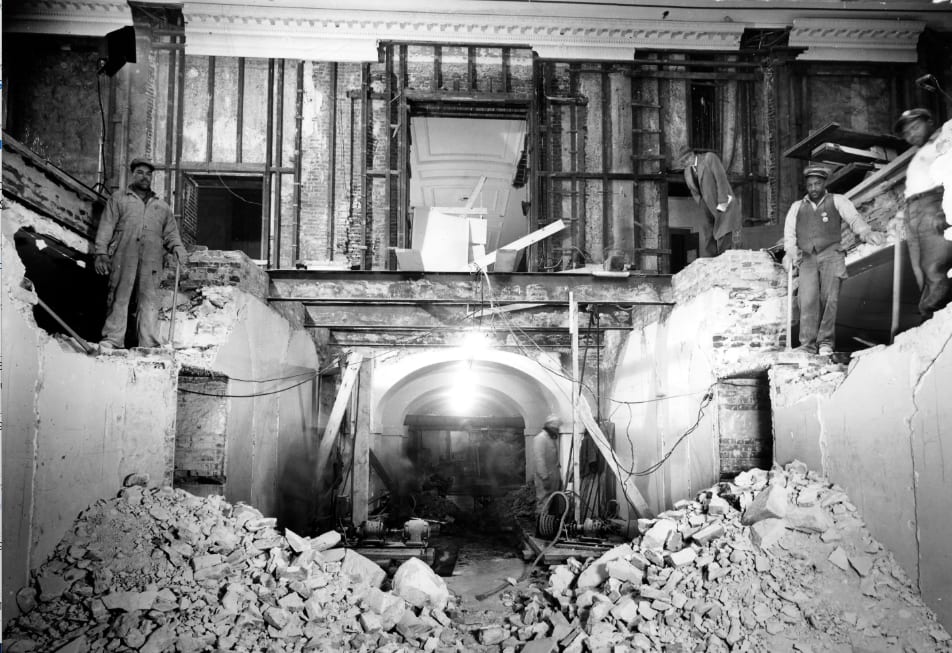
One afternoon in 1948, Margaret Truman’s piano leg punched straight through the floor of her sitting room above the Family Dining Room. The supports had rotted away, the main beam split clear through. The ceiling below had sunk nearly a foot and a half. Harry Truman worried about the election year. His presidential home collapsing underneath him was the last image he wanted America to see.
Story continues after the book ad…
The Blueprint
Half blueprint, half confession. Irreverent. Caffeinated. Built to outlast hype.

☕A Coffee with Steve publication.

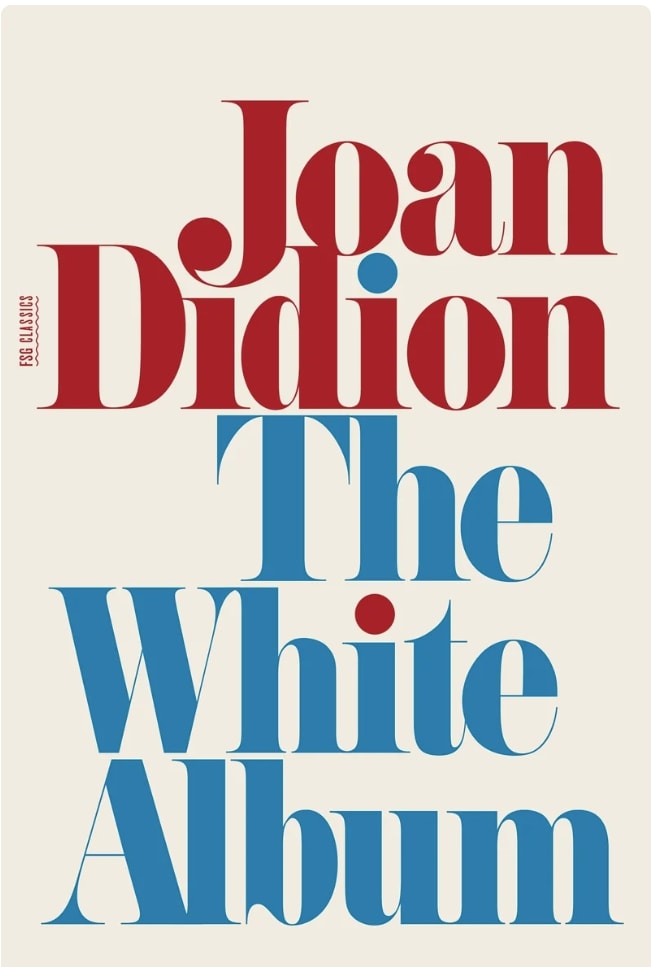
Joan Didion’s field report from the first great national nervous breakdown, published in 1979, The White Album records indelibly the upheavals and aftermaths of the 1960s.
Examining key events, figures, and trends of the era—including Charles Manson, the Black Panthers, and the shopping mall—through the lens of her own spiritual confusion, Joan Didion helped to define mass culture as we now understand it. Written with a commanding sureness of tone and linguistic precision, The White Album is a central text of American reportage and a classic of American autobiography.
In particular, in the essay Many Mansions, Didion tours a new federal building in Sacramento. From there she unspools into an essay about California’s architecture of governance: the literal edifice complex of the state, and by extension, of the American dream itself.
Didion reads the modernist glass and concrete style as a theology of order—an attempt to banish chaos through design—but she knows the chaos hasn’t gone anywhere. She contrasts the gleaming government complex with the flimsy tract houses sprouting in the valley—structures built fast, meant to look eternal, already decaying.
The closing movement turns biblical—“In my Father’s house are many mansions”—but Didion’s California version is secular, bureaucratic, lonely. The architecture promises salvation while citizens quietly drown in the myth of control and paperwork.
Order The White Album Are Here today at Bookshop.org
Bookshop.org works to connect readers with independent booksellers all over the world. Local bookstores are essential community hubs that foster culture, curiosity, and a love of reading, and Bookshop.org is committed to helping them thrive. Every purchase on the site financially supports independent bookstores.


Everything in the postwar landscape—freeways, fallout shelters, shopping malls—was built to look calm under pressure. The future seemed to gleam. Main Street storefronts refaced themselves in aluminum facades to look more like cars, and finned cars began to look like rockets.
The nation’s living rooms were atomic-age confessionals.
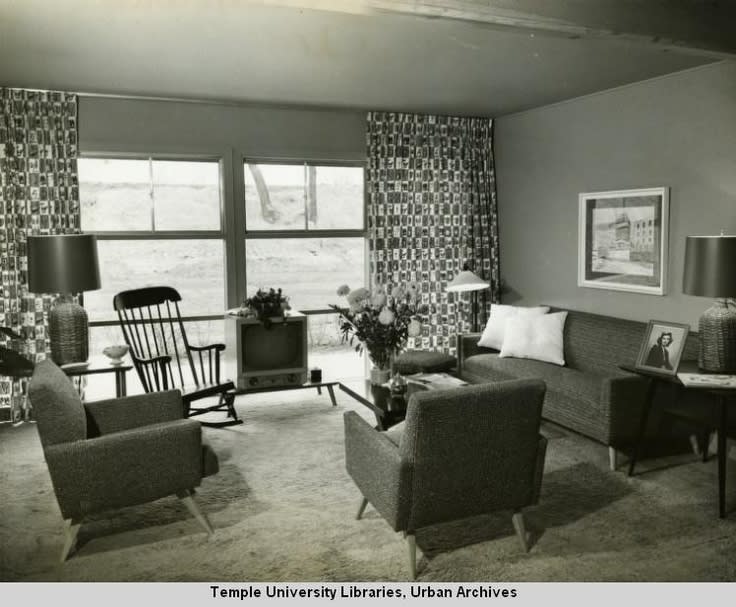
Every oversized Levitttown picture window became a stage for ideological performance: your curtains, your cocktails, your smile—all small pledges of allegiance. McCarthyism didn’t just live in Senate hearings; it seeped into architecture, etiquette, and neighborly surveillance. Just as the House Un-American Activities Committee demanded proof of loyalty, the suburban household demanded proof of conformity. Everyone became both the watcher and the watched.

Europe had proven that civilization could be barbaric in a tuxedo. Truman’s renovation ripped out the gentleman’s parlor, kept the white façade for the postcards, and modernized the bones. The inside became a 1950s infrastructure fantasy of ducts, wiring, bureaucratic order.
The new steel-and-concrete structure that replaced the old timber bones introduced something novel: a networked building. It had concealed conduits, modern electrical wiring, ventilation shafts, intercom systems, and telephone lines routed through walls and subfloors. All of that meant centralized control of communications, discrete wiring access points, and, crucially, the ability to retrofit hidden devices later.
Truman’s White House became the prototype for a nation learning to live inside its own self-surveillance.
When Cold War paranoia moved in. Ike oversaw technological modernization that included secure communications, telephone scramblers, and the first generation of “situation room” planning.
By the late 1950s, the Secret Service began using closed-circuit monitoring for certain entrances — early analog precursors to CCTV. The White House also installed dedicated communications rooms for military and diplomatic signals.
By the Kennedy era, hidden microphones, tap-proof rooms, and closed-circuit systems were standard. Lyndon Johnson expanded the internal communications network, and Nixon’s infamous recording system (installed in 1971) literally exploited that same infrastructure lineage — the ducts, wiring channels, and power access made possible by the 1952 rebuild.
In 1961, First Lady Jacqueline Kennedy launched an aesthetic/historic restoration: she brought in decorator Dorothy “Sister” Parish, historian advisors, and established that the White House should function as a museum as well as a residence. Someone installed a bowling alley and a movie theater. In 2020, Melania Trump commissioned a redesign of the Rose Garden: new limestone walk (to meet ADA compliance), relocated trees, white & pale-pink roses, turf improvements.
By this time, much of the original White House interior is gone; you’re looking at layers, not authenticity, and without Truman’s modernization, Watergate wouldn’t have even been technically feasible.
Each era reflects a push-pull of heritage and symbolism versus function.
Of course, the White House means something. A Georgian daydream, aristocracy with better manners, the Palladian symmetry that is refinement and virtue, a kind of Enlightenment feng shui for democracy.
The White House performs reassurance.
America’s id and ego wrapped in neoclassical marble. A throne that does not need to call itself a throne. Every press briefing, handshake, and photo op maintains the illusion that the voice coming from the podium is the voice of the nation, and not just one ambitious human’s script. The mirror Americans can’t stop gazing into. The world’s lighthouse, or maybe searchlight, depending which side you’re on. To allies, stability. To enemies, the imperial nerve center, the glowing target of global resentment. The American brand, the logo of empire, equality, and entertainment.
Enslaved people built those walls, laid the bricks, carved the stone, then vanished from the official narrative. Our nation’s central symbol was, in its construction, an act of bondage. That dissonance between ideals and reality—how the United States continues to present itself as a refuge for the persecuted, a country defined by opportunity and openness, yet the current administrative reality—detention centers, restrictive quotas, the narrowing of asylum definitions. The language shifted from give me your tired, your poor to show me your papers. The programs meant to lift the weary masses—SNAP, Medicaid, asylum supports, masked secret police, people forcibly removed from streets and shoved into unmarked black SUVs…
Every press secretary, every policy advisor, every intern learns that the White House runs on narrative management.
Ballroom be damned.

“Good writing is always about things that are important to you, things that are scary to you, things that eat you up.” – John Edgar Wideman
🌐 Explore more at stevebargdill.com
Coffee With Steve is free. If you enjoyed this post, you can tell Coffee With Steve that their writing is valuable by spreading the word and sharing with a friend.

☕Upcoming in WICKED MOXIE
Before the Ninja Turtles took over Saturday mornings, they were two guys with a photocopier and a dream—and a Portsmouth kid named Ralph who bought 500 copies just to help them pay back their uncle. From a sixth-grader hustling comics at Mars Bargainland to the man who helped launch a cultural phenomenon, Ralph DiBernardo built Jetpack Comics into New Hampshire’s beating heart of geekdom—a twenty-year love letter to long boxes, ink fumes, and the beautiful chaos of imagination.



About this publication.
Coffee with Steve is an independent publication by Steve Bargdill. Views are my own and do not represent Keller Williams Coastal & Lakes & Mountains Realty (“KWCLM”) or any other organization. Each Keller Williams Office is Independently Owned and Operated.
Not advice. Content is informational and educational; it is not legal, tax, or financial advice and does not guarantee results. Talk to a licensed professional who knows your situation before you act.
No agency created. Reading this does not create an agency relationship or agreement for services. Brokerage representation requires a separate written agreement with KWCLM.
Licensure. I am licensed in New Hampshire. Equal Housing Opportunity.
Wire-fraud warning. During representation by Keller Williams, you will never be asked via email to wire funds to anyone, including a title company. Do not follow email wiring instructions. Always verify by phone using a trusted number.
You can reach Keller Williams Coastal and Lakes & Mountains Realty at 603-610-8500 or Steve Bargdill directly at 603-617-6018.
Pronouns: he, they